THE PROMENADE, THE DIRECTION, AND WHAT IS AT THE OTHER END01
Can you walk across the Brooklyn Bridge?
Yes, on a raised promenade between the roadways that is now for people on foot alone. Which way to walk, where to start and finish, how long it takes, when it is least crowded, and what to do in Brooklyn at the far end.
The answer in full02
Read on
The short answer
Yes, and you should. The Brooklyn Bridge was built in 1883 with a promenade for walkers raised above its two roadways, and crossing it on foot is one of the best free things to do in New York. The walk is a little over a mile, from Park Row beside City Hall in Manhattan to Brooklyn, and at an unhurried pace, with stops at the towers for the view, it takes most people around an hour.
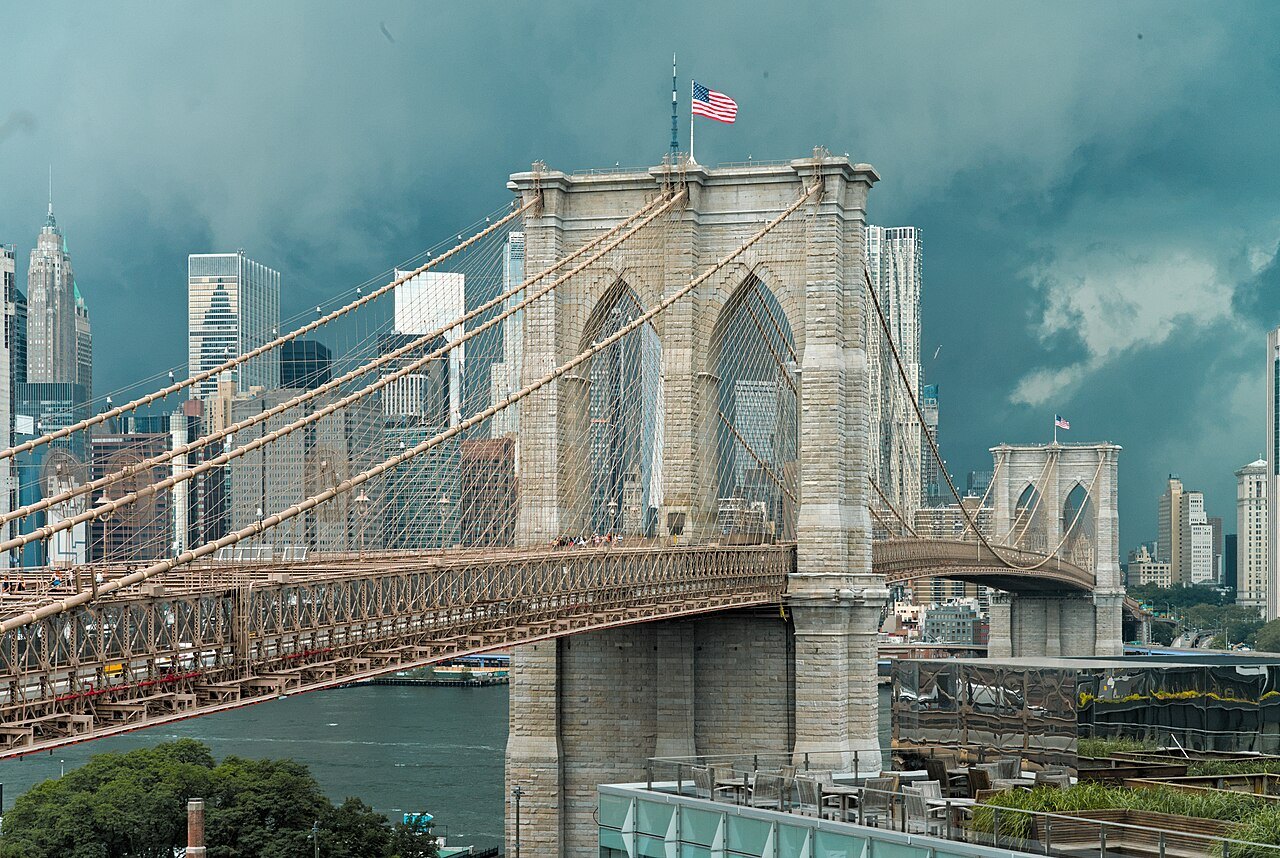
The only real decisions are which way to walk and when. Walk toward Manhattan if you can, and go early in the day or in the evening, when the promenade is least crowded.
A bridge built to be walked
When it opened on May 24, 1883, the Brooklyn Bridge was the first fixed crossing of the East River and the longest suspension bridge in the world, with a main span of about 1,595 feet between its towers. Its designer, John A. Roebling, planned from the start for an elevated promenade down the middle, a leisurely pathway for people on foot, raised about eighteen feet above the traffic on either side.
New Yorkers took to it at once. By 1892 some four and a half million pedestrians a year were crossing it, free of charge, and it quickly became one of the city's favorite places for a stroll. The promenade was rebuilt in a restoration completed in 1954, and it still follows the original line, climbing gently from each end to the two great stone towers and running level between them.
Walkers only now
For decades the promenade was shared by walkers and cyclists, and as the bridge grew more popular walkers and riders increasingly got in each other's way; by the late 2010s about ten thousand pedestrians and three and a half thousand cyclists used it on an average weekday. In 2021 the city built a protected two-way bike path on the Manhattan-bound roadway, replacing one lane of cars, and the promenade became a path for people on foot alone.
Even so, the walkway was still often overcrowded, partly because of the vendors who set up along it, and in January 2024 all vendors were banned from the bridge. The same month, new LED lights were switched on along the span. The walk today is calmer than it has been in years, though at midday on a fine weekend it is still busy.
Which way to walk
The skyline is the point of the walk, so it matters which way you face. If you walk from Manhattan to Brooklyn, the towers of Lower Manhattan, with One World Trade Center above them, are behind you, and you will keep turning around. If you walk from Brooklyn to Manhattan, they are in front of you the whole way, framed by the cables, growing larger with every step.
The easiest way to do that is to take the subway to Brooklyn first. Get off near the Brooklyn end of the bridge, in the neighborhoods of Dumbo or Brooklyn Heights, find the stairs up to the promenade, and walk back toward Manhattan. You finish at City Hall, with Lower Manhattan's sights around you, and the whole walk has the skyline for its backdrop. Getting around explains the subway.
What to look for
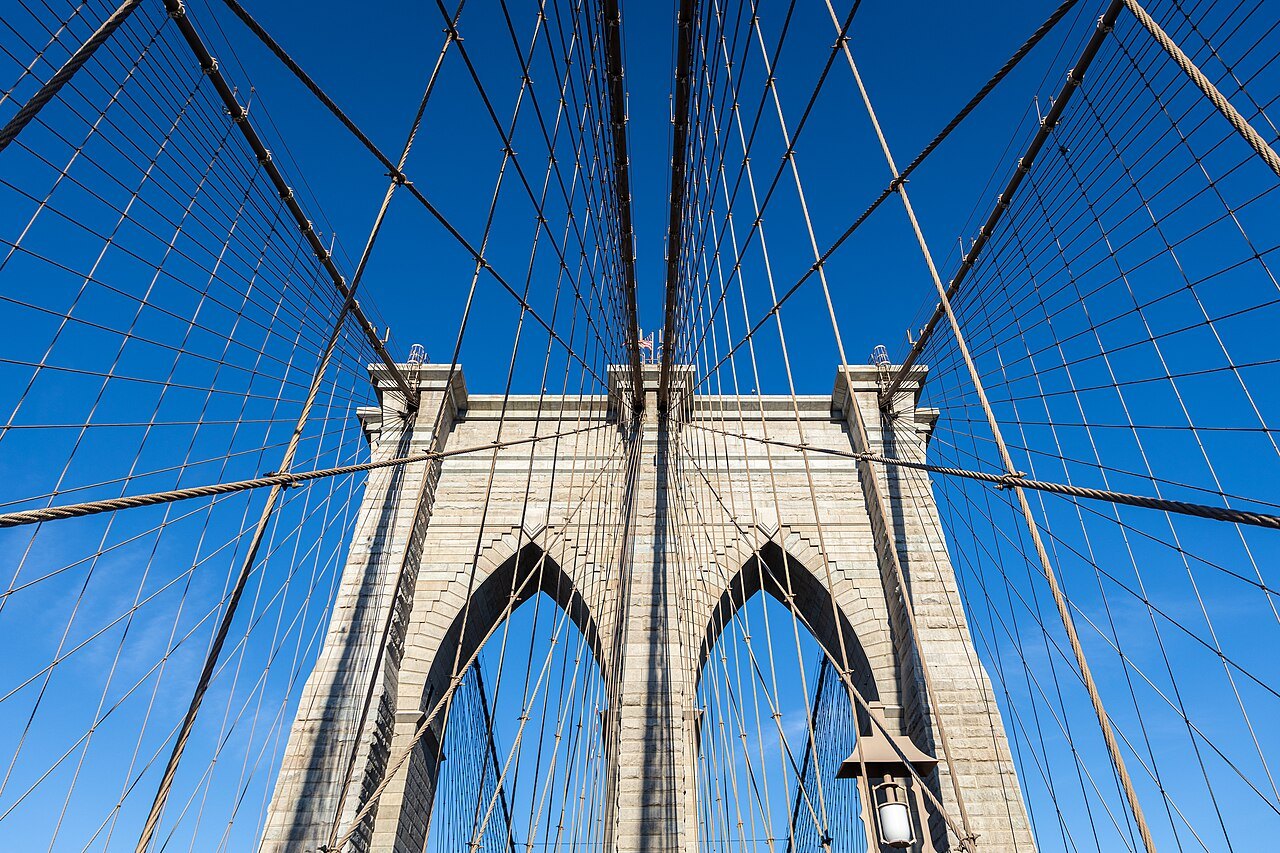
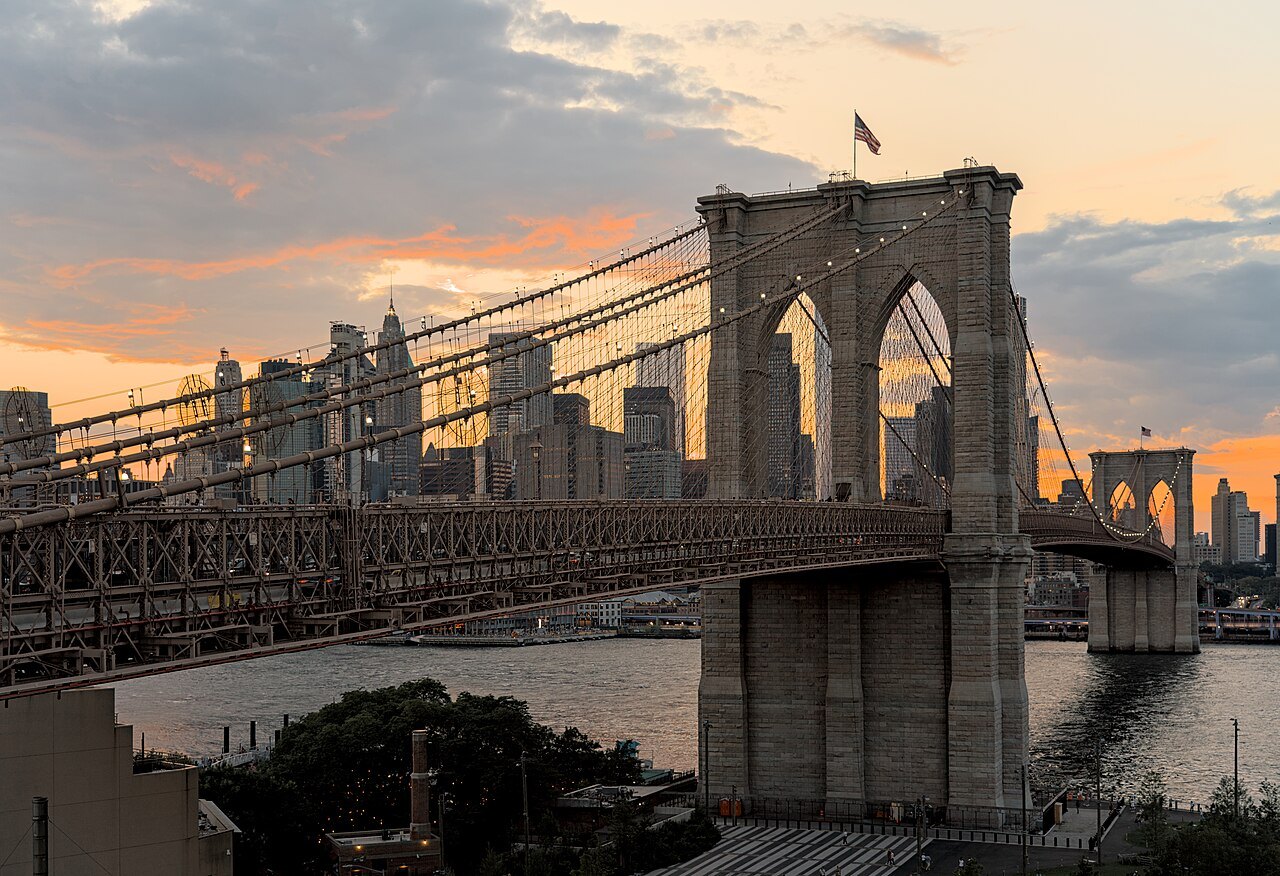
The towers are the bridge's signature. Built of limestone, granite and cement, they rise 278 feet above the water, and each is pierced by a pair of tall pointed arches in the Gothic Revival style. At each tower the promenade widens into a balcony that overhangs the roadways, and this is where people stop to look up. Above you is the web that makes the bridge's famous picture: four main cables sweeping down from the tower tops, vertical suspenders hanging from them, and hundreds of diagonal stays radiating out from the towers.
Look down and you see the traffic moving beneath your feet, and beyond it the river, with the Manhattan Bridge upstream and the harbor and the Statue of Liberty downstream. At the Brooklyn end, the city spreads out in low neighborhoods, a sudden change from the towers behind you.
At the Brooklyn end
Below the bridge on the Brooklyn side lies Dumbo, short for Down Under the Manhattan Bridge Overpass, an old warehouse district of cobbled streets between the two bridges, now full of galleries, shops and cafés. Its most famous view is the Manhattan Bridge framed between the buildings on Washington Street, looking north from Water Street, and there is usually a crowd of photographers in the middle of the road.
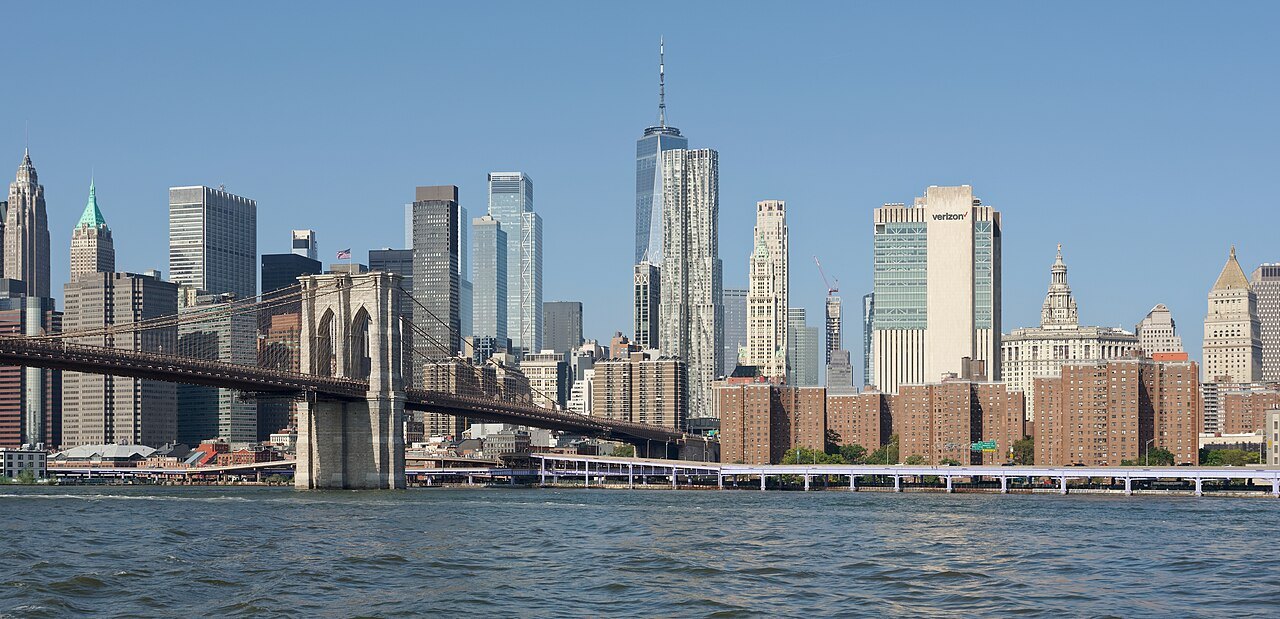
Along the water runs Brooklyn Bridge Park, eighty-five acres of lawns and piers built on the old industrial waterfront and finished in 2021. It has Jane's Carousel of 1922, the old Empire Stores and Tobacco Warehouse, and the historic Fulton Ferry Landing, and from its piers you get the view of the bridge and the skyline together.
The ferry has a long history here: the first ferry landing on this shore opened in 1642, on the site of the park's Empire Fulton Ferry section, and for more than two centuries it was the only way across. Today NYC Ferry's South Brooklyn route has called at Piers 1 and 6 since 2017, which makes a fine loop: walk out over the bridge and return by water, or the other way round. Day trips has more on Dumbo and the park.
Practical notes
The promenade is free and open to anyone on foot. Go early in the morning or in the evening for the fewest people and the best light; sunset from the bridge, with the lights of Lower Manhattan coming on, is one of the finest sights in the city. Keep to one side when you stop for photographs, so that people can pass, and stay off the bike path, which is now on the roadway.
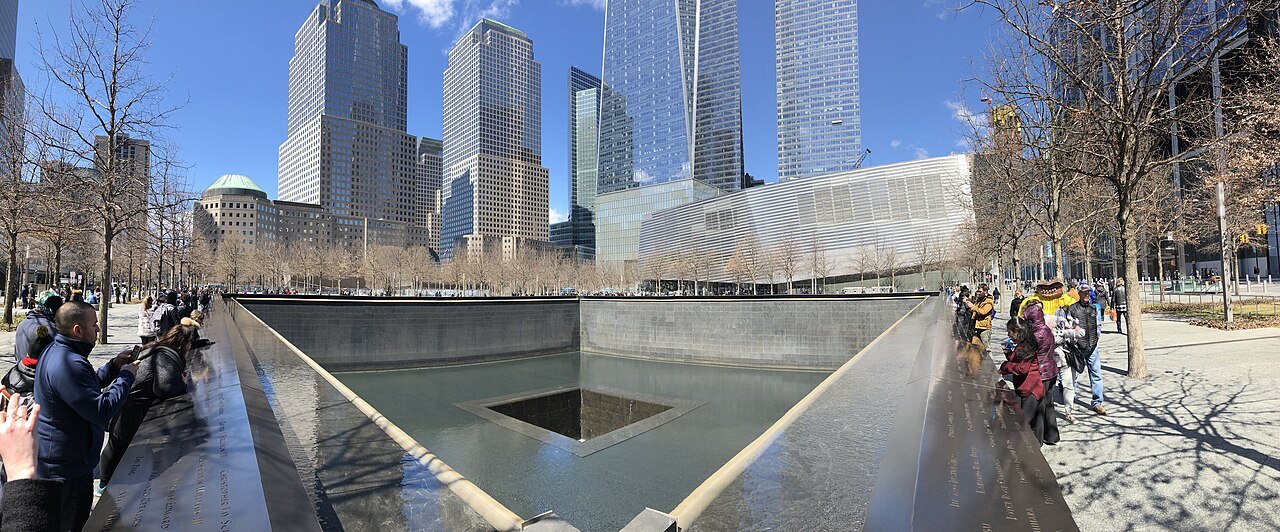
Bring a layer even in summer, since the wind over the river is stronger than in the streets, and wear comfortable shoes: the climb to the towers is gentle but long. Back on the Manhattan side, the 9/11 Memorial and Wall Street are a short walk away.
Read next03
More from the journal
- The Statue of Liberty and Ellis IslandHow do you visit the Statue of Liberty and Ellis Island?Every visitor travels on the same ferry, sold by one company. Which of the three tickets you need, why the crown sells out, how security works, how long to allow, and how to fit Ellis Island into the same day.Read the piece →
- The GridWhat is Manhattanhenge, and where should you watch it?Four days a year the sun rises or sets exactly along Manhattan's cross streets, because the grid of 1811 is tilted 29 degrees. Why it happens, when, the difference between the half sun and the full sun, and which streets give the best view.Read the piece →
- Getting HereHow do you get from JFK Airport to Manhattan?There is no direct train from JFK to Manhattan, but there are three good ways in: AirTrain to Jamaica and the Long Island Rail Road, AirTrain to the subway, or a taxi at a flat rate. How each one works, what it involves with luggage, and how to choose.Read the piece →