Home · Sights · The Flatiron Building and Madison Square
What you are looking at01
The Flatiron Building and Madison Square
Fifth Ave · Broadway · E 23 St
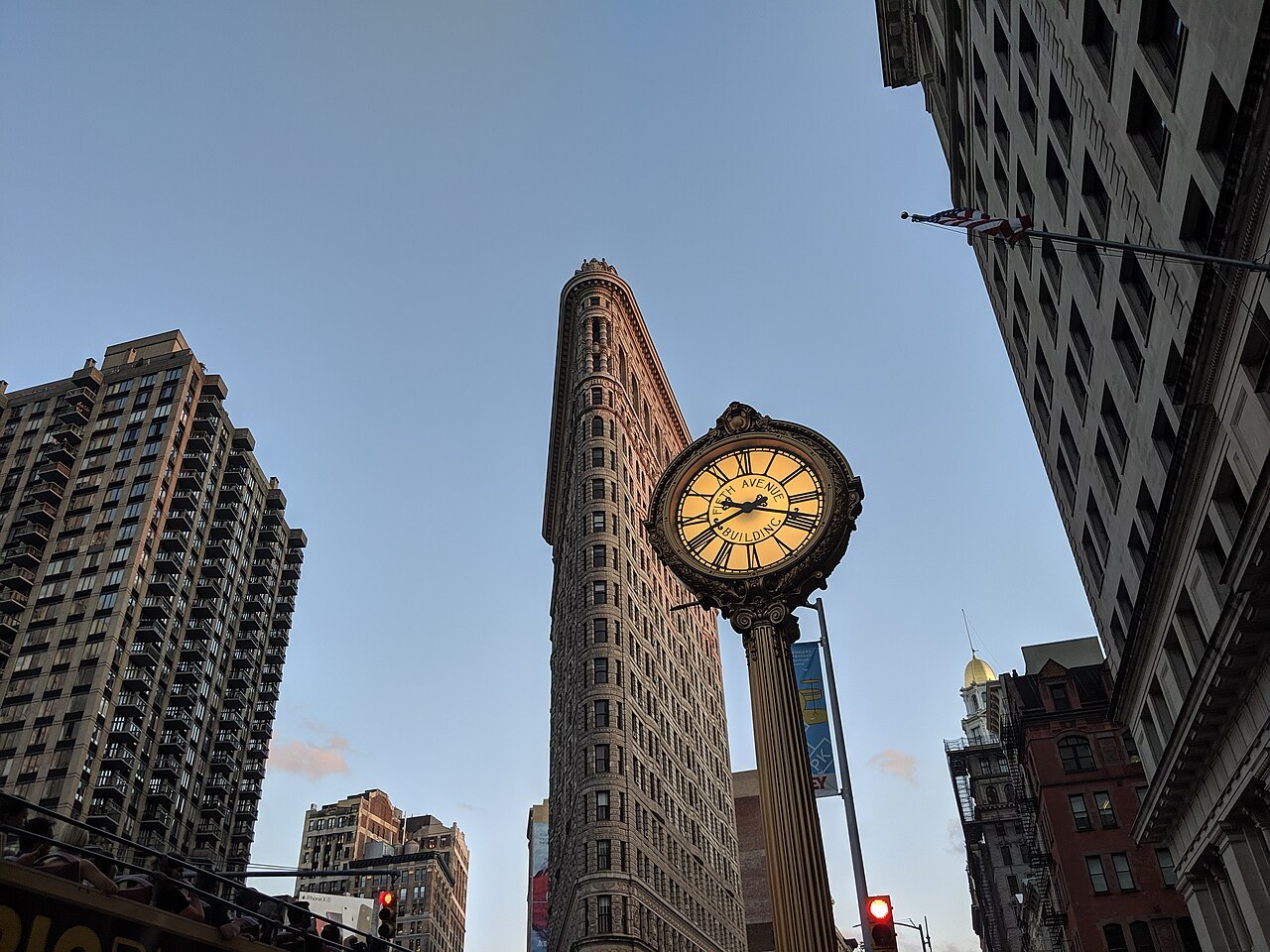
- 1The prowThe narrow northern tip of the Flatiron, where Fifth Avenue and Broadway close to a rounded point.
- 2The facadeA limestone base and glazed terracotta above, detailed like a Renaissance palace stretched upward.
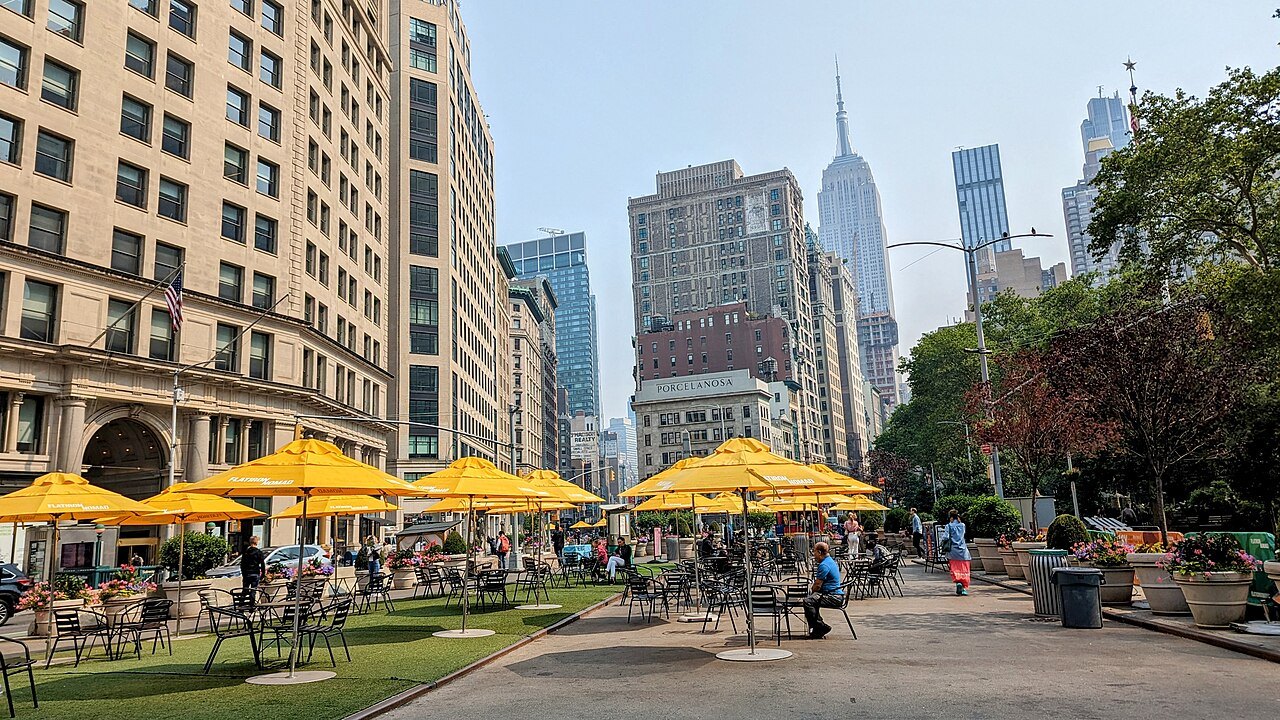
- 3The view from the plazaThe pedestrian plaza north of the building, the classic place to photograph it.
- 4Madison Square ParkA little over six acres of lawns and old trees, laid out on land set aside in 1807.
- 5The Farragut MemorialAugustus Saint-Gaudens's admiral on a base by Stanford White, at the park's north end.
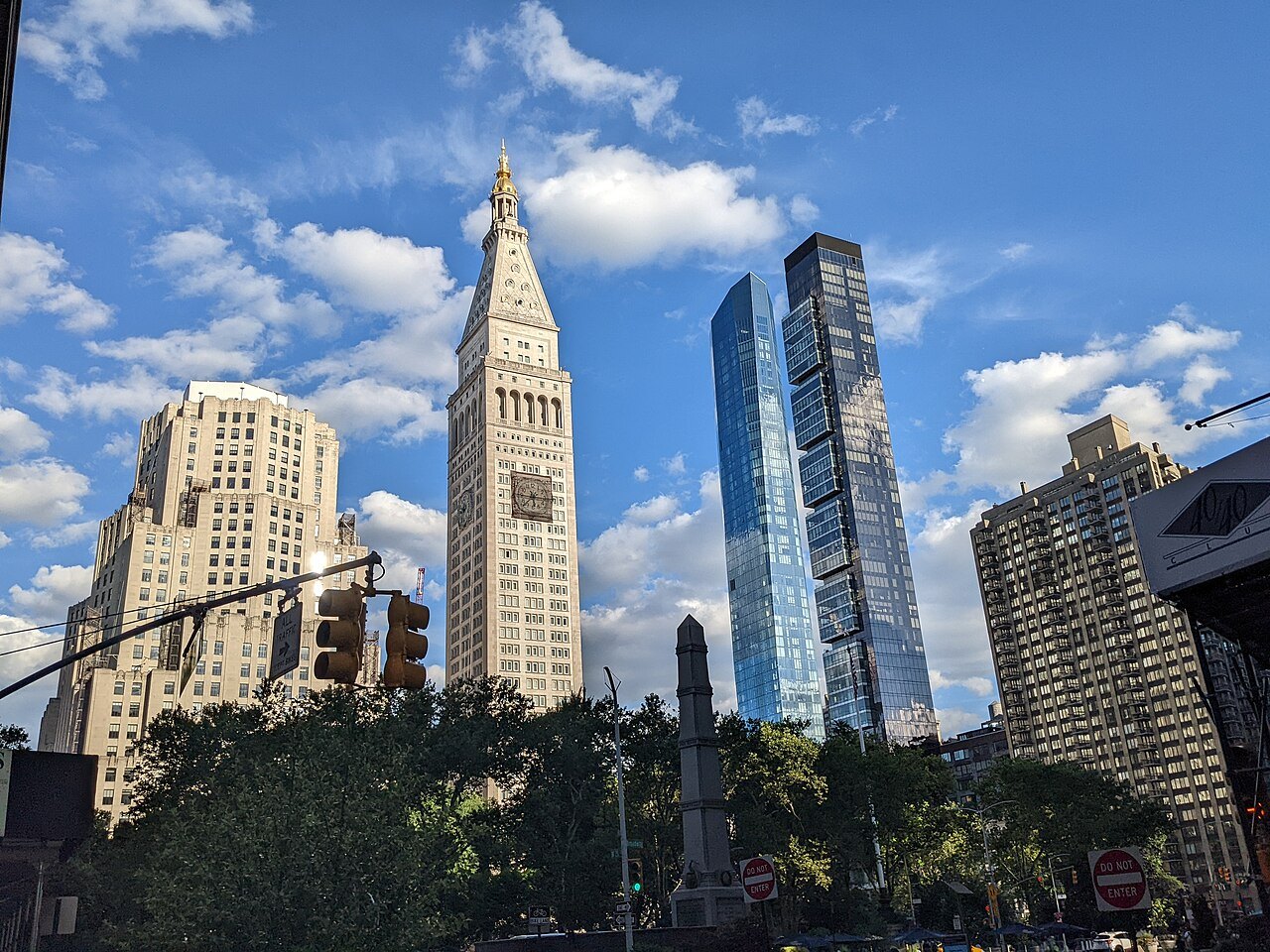
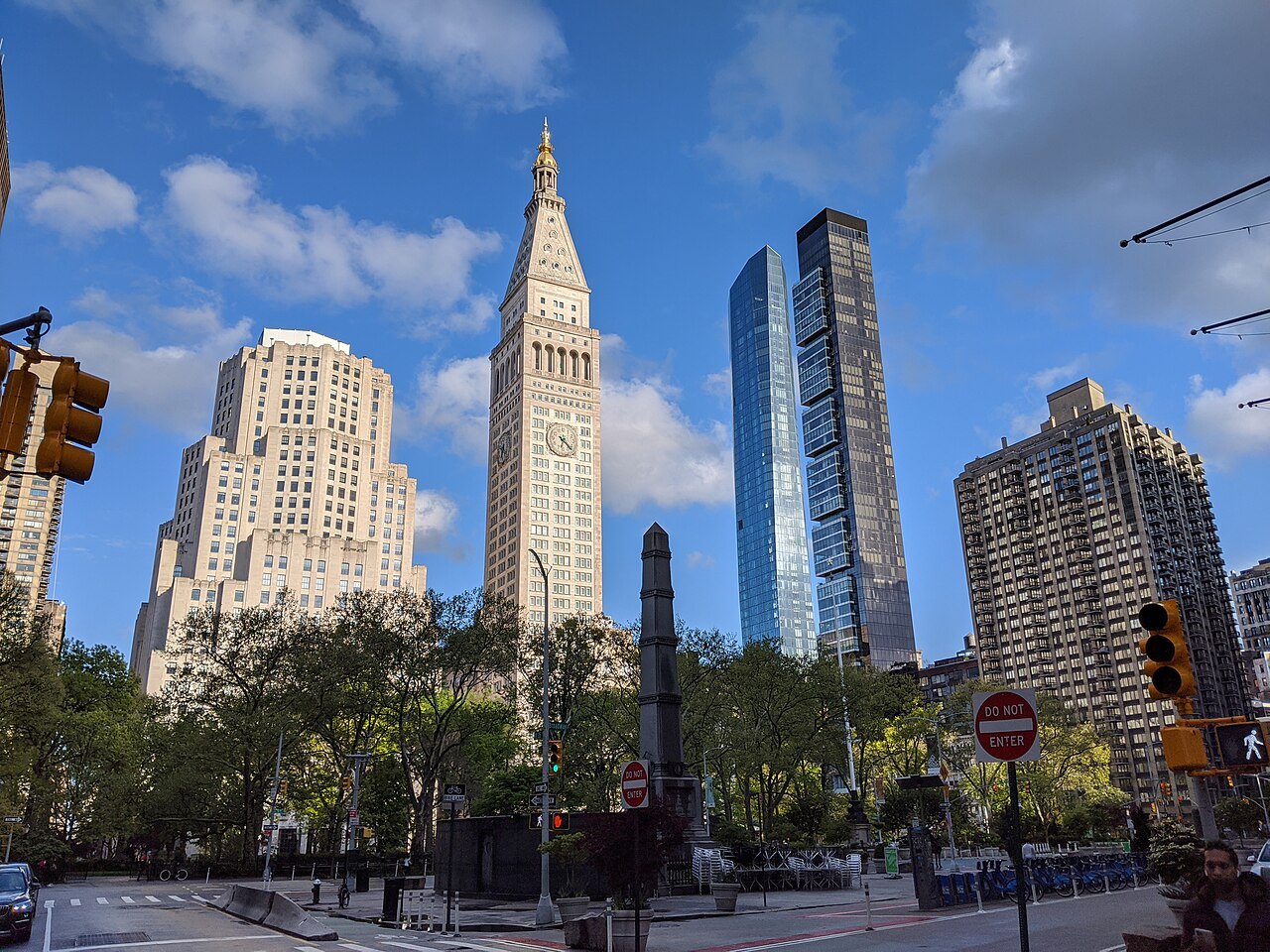
- 6The towers around the squareThe Met Life clock tower, the New York Life Building and the Appellate courthouse.
The sight in full02
Reading the place
Why it matters
At 23rd Street, Broadway cuts diagonally across Fifth Avenue, and the two streets leave behind a thin triangle of land. On it stands the Flatiron Building, twenty-two stories and 307 feet tall, opened on October 1, 1902. Its shape, narrowing to a point at the northern end like the prow of a ship, makes it instantly recognizable, and more than a century after it opened it is still the building that best explains what a skyscraper on a Manhattan street corner can be.
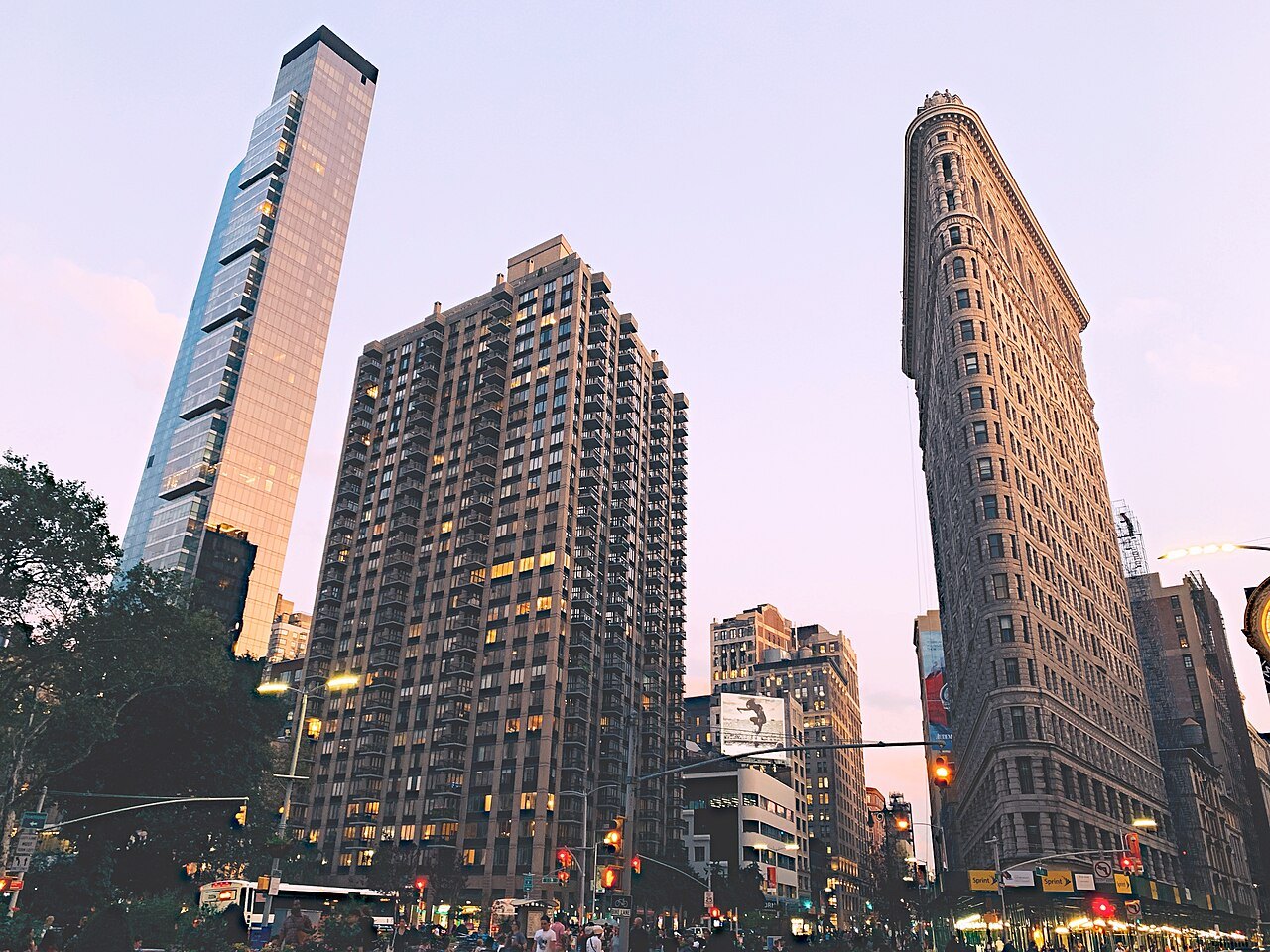
It is also the best place to see what Broadway does to the grid. Everywhere else in Midtown the blocks are rectangles; wherever Broadway crosses an avenue, it leaves a triangle and a square, and here the triangle became the building and the square became Madison Square.
The building
The Flatiron was built as the headquarters of the Fuller Company, a construction firm, and was originally called the Fuller Building. The Chicago architect Daniel Burnham designed it with Frederick P. Dinkelberg as a vertical Renaissance palace with Beaux-Arts detail: a three-story base clad in limestone, a long shaft of glazed terracotta, and an ornate crown. The steel frame, by the engineers Purdy and Henderson, was designed to withstand four times the strongest wind the area might see.
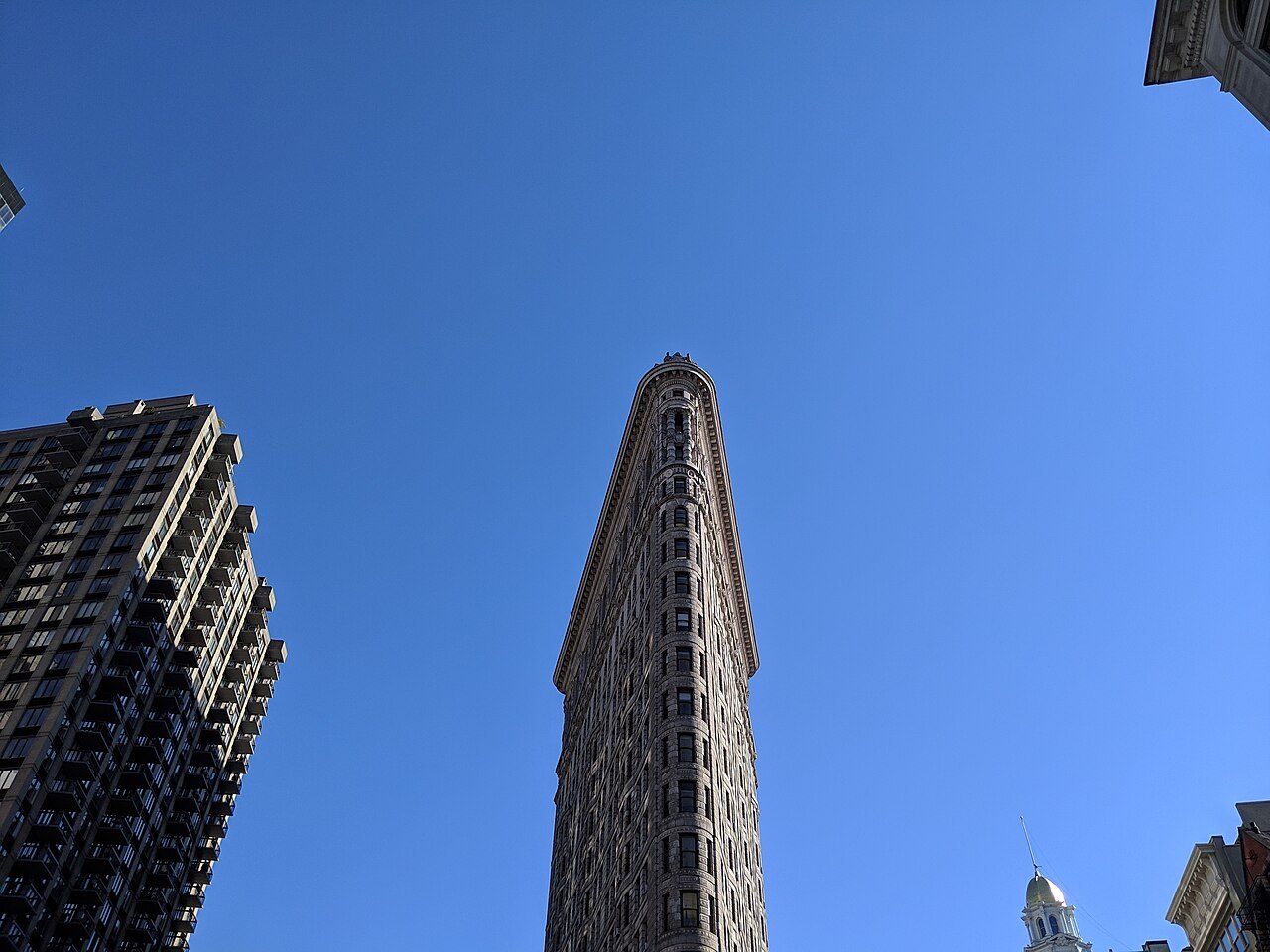
New Yorkers were not sure it would stand. They called it Burnham's Folly, and they soon renamed it for its shape, which recalls a cast-iron clothes iron. The wind that swirls around its narrow tip was said to lift women's skirts and scatter banknotes, and according to some accounts this gave rise to the old slang twenty-three skidoo, although the phrase's origin is disputed. The building became a New York City landmark in 1966 and a National Historic Landmark in 1989.
What you actually see
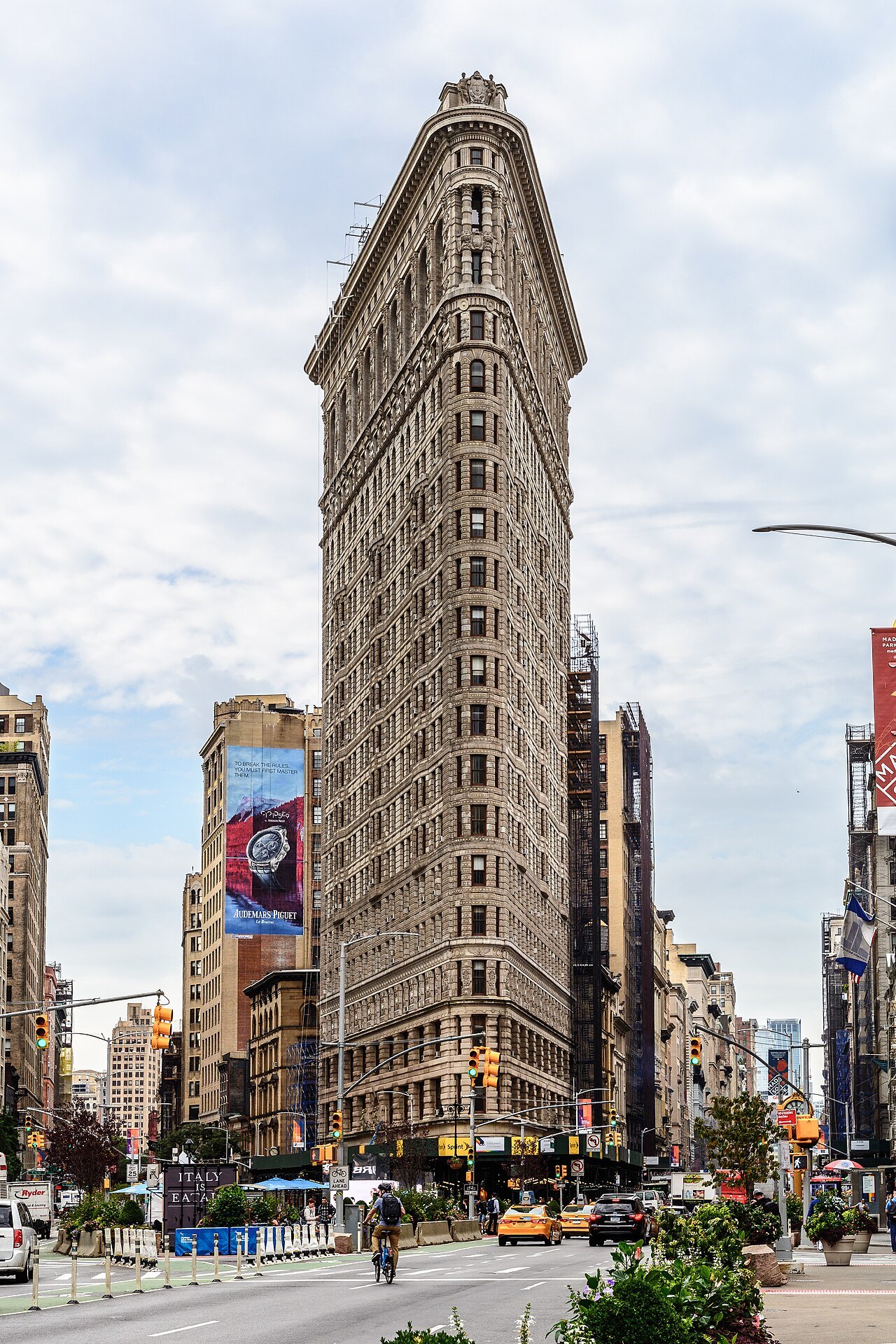
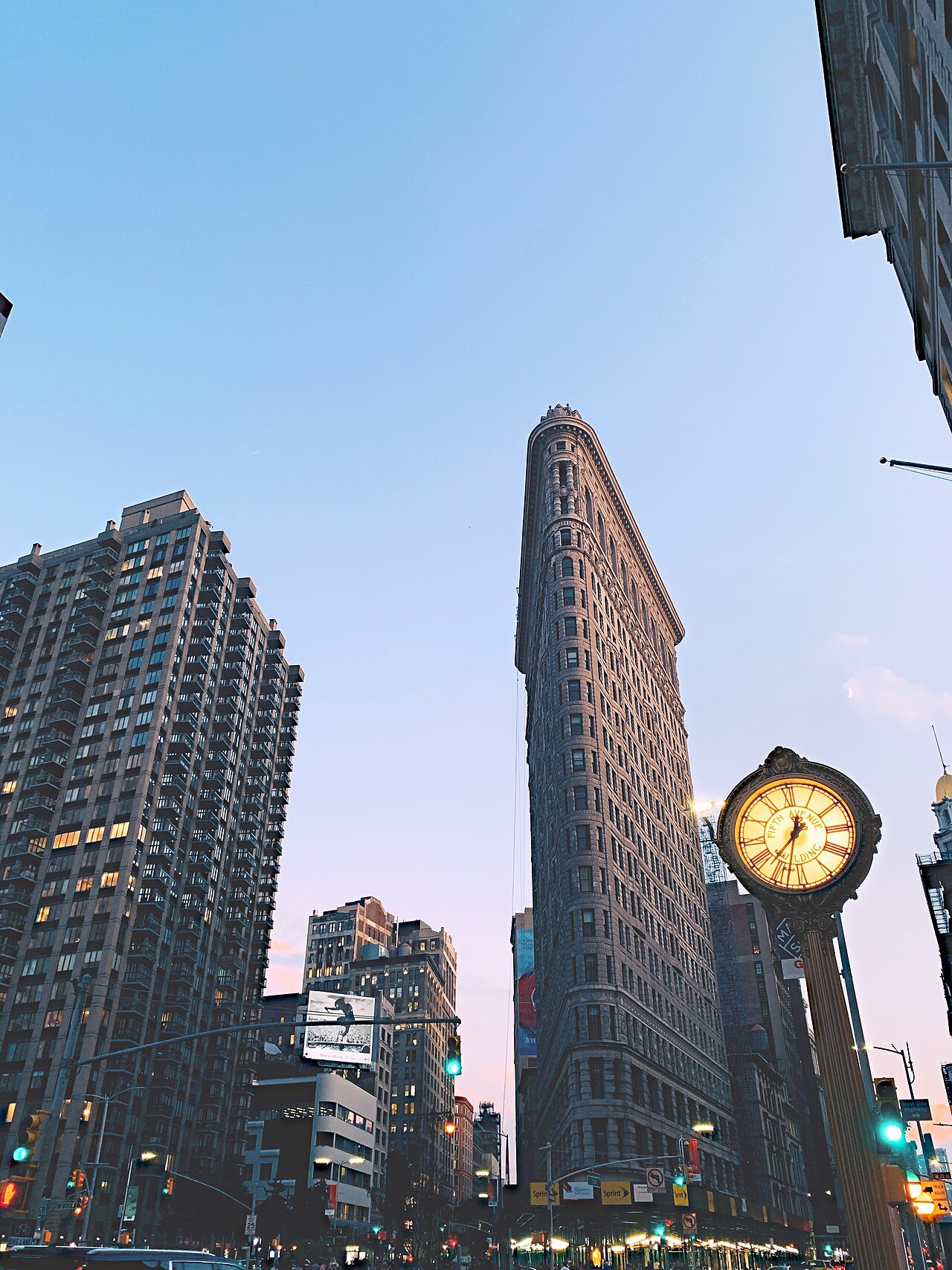
The building is best seen from the north, from the pedestrian plaza where Broadway and Fifth Avenue meet at 23rd Street. From there the prow faces you head-on, and the two long walls run away from it at a sharp angle, so that the building seems to be no thicker than a wall. At the back, on 22nd Street, it is 87 feet wide.
Look up at the facade and the detail becomes visible: bands of terracotta ornament, window frames set in rows so close they read as a woven pattern, and the heavy cornice at the top. At the tip there is a one-story extension at street level, the so-called cowcatcher, added during construction as a shop.
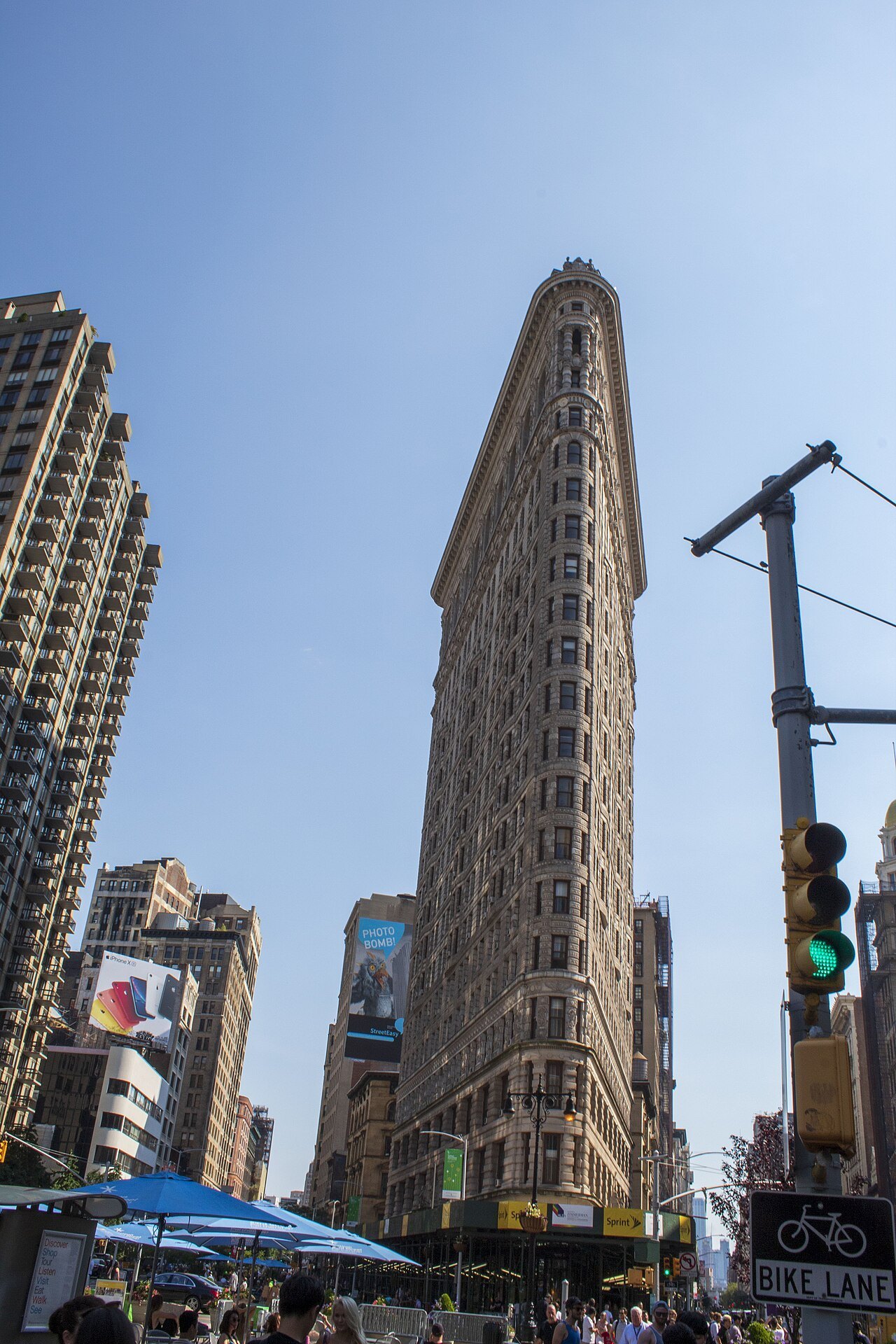
The building has been under renovation in recent years. Its owners began work in 2019, and in October 2023 they announced a conversion to residential condominiums, planned for completion by 2026, so parts of the facade may be covered by scaffolding when you visit and the interior is not open to the public.
Madison Square
Across 23rd Street lies Madison Square Park, a little over six acres, which opened as a public park on May 10, 1847. The land had been set aside in 1807 as a parade ground and arsenal, far north of the city of the time. As the city grew up around it, the square became an aristocratic neighborhood of brownstones and mansions, where Theodore Roosevelt and Edith Wharton were born, and grand hotels such as the Fifth Avenue Hotel, which could house eight hundred guests, lined its edges.
It has a surprising history. From 1876 to 1882 the torch-bearing arm of the Statue of Liberty stood in the park to raise money for the statue's pedestal. The first two arenas called Madison Square Garden stood on the northeast corner of the square, and the name survived when the arena moved uptown; the present Garden is nowhere near here.
At the north end of the park the Farragut Memorial of 1881, with a bronze of the admiral by Augustus Saint-Gaudens on a base by Stanford White, honors the Civil War commander remembered for the order to go full speed ahead at Mobile Bay. On an island west of the park an obelisk of 1857 marks the tomb of General William Jenkins Worth, after whom Fort Worth in Texas is named. Along the south edge stands the Eternal Light Flagstaff, dedicated in 1923 to the soldiers and sailors who came home from the First World War.
The towers around the square
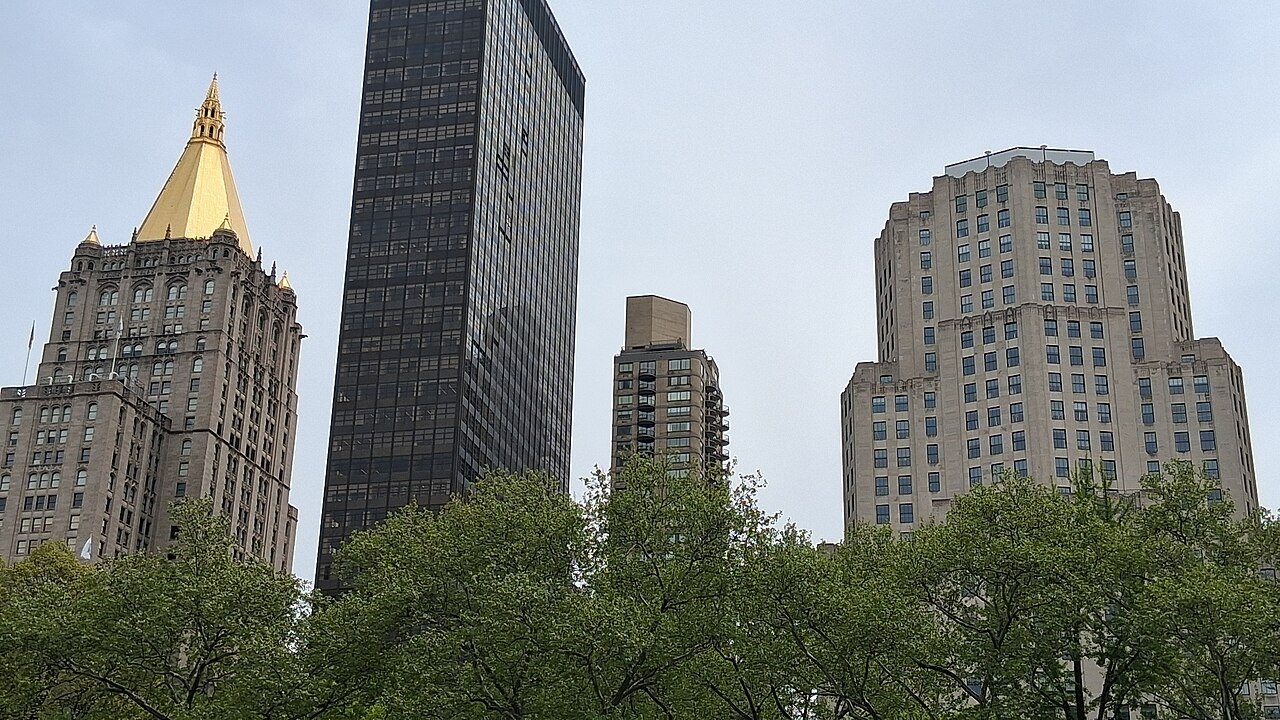
Madison Square is ringed by landmarks. On the east side rises the Met Life Tower; in 1908 a newspaper installed a searchlight among its girders to signal election results. North of it stands the gilded pyramid of the New York Life Building, built on the site of the old Madison Square Garden. Between them, the small marble Appellate Division Courthouse faces the park across Madison Avenue.
How to visit
The plaza, the park and the view of the building are free. The park is a good place to sit with lunch; the Shake Shack burger stand opened here in 2004. Allow half an hour for the square and the building, longer if you walk around the landmarks on its edges.
Several subway lines stop at 23rd Street along Broadway and Park Avenue. The grid explains why Broadway makes triangles wherever it crosses an avenue, and where to stay covers the Flatiron district as a base.
Nearby
Walk north up Fifth Avenue to the Empire State Building at 34th Street, or south to Washington Square. West along 23rd Street lies the High Line.
Where to go next03
Nearby
- Nearby · Fifth Ave · W 34 StThe Empire State BuildingThe Art Deco tower that went up in thirteen and a half months during the Depression, rising 1,454 feet to the tip of a mast once meant for airships, with an open-air deck on the 86th floor and a view over the whole grid.Read the page →
- Nearby · Fifth Ave · Washington SqWashington Square and Greenwich VillageA marble arch at the end of Fifth Avenue, a square that was once a burial ground and a parade ground, and around it the crooked streets of a village older than the grid, where the Beats, the folk singers and the Stonewall uprising began.Read the page →
- Nearby · Gansevoort St → W 34 StThe High LineA freight railroad of 1934 that runs through the West Side at third-floor height, turned into a park of wild planting and lookouts, a mile and a half long, with a new island park at one end and a climbable sculpture at the other.Read the page →