A CENTURY OF THE BALL DROP01
How did the New Year's Eve ball drop begin in Times Square?
How a newspaper's tower gave Times Square its name and its famous New Year's Eve ball drop.
The answer in full02
Read on
Why it matters
Times Square is the bowtie of open space where Broadway cuts diagonally across Seventh Avenue in Midtown, spanning about five blocks between 42nd and 47th Streets. It ranks among the busiest pedestrian places in the world and sits at the center of the Theater District, home to most of the city's Broadway playhouses.
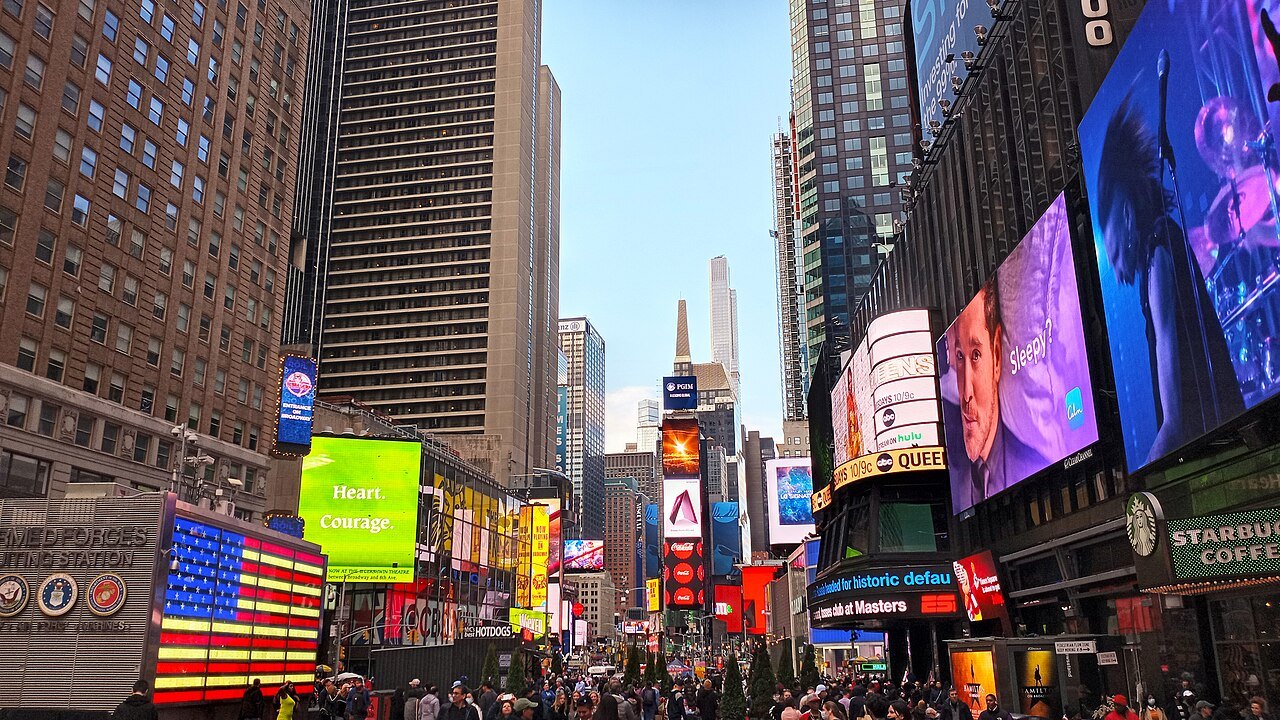
On an ordinary day something like three hundred thirty thousand people cross the square, and on its busiest day the number climbs past four hundred sixty thousand. That crush of people, the ring of giant video screens, and the diagonal slash of Broadway across the numbered grid make Times Square unlike anywhere else in the grid of Manhattan streets.
Of all the nights the square sees, none is as famous as New Year's Eve, when a lighted ball descends from a tower at its southern tip and a crowd that can top a million watches it land. The custom is now more than a century old, and its origin explains both the tower and the square's old habit of advertising itself in light.
How it got its name
Until 1904 the square was called Longacre Square, named for Long Acre in London, the center of that city's horse and carriage trade; this stretch of Broadway had once been New York's own carriage-making quarter. The name changed when the publisher of The New York Times moved the paper into a new tower at the square's southern end.
He also persuaded the city to build a subway station beneath the tower, and on April 8, 1904, the city renamed Longacre Square after the newspaper. The Times Building, now called One Times Square, still stands at the narrow southern point where Broadway and Seventh Avenue meet, the tower from which the New Year's Eve ball would later be lowered.
The newspaper's own offices did not stay in the building for long, but the name endured, and the tower became the fixed point for the square's best-known yearly event. Three years after the renaming, that same rooftop gave New York the first version of a custom still followed every New Year's Eve.
The first ball drop
On December 31, 1907, a lighted ball was lowered from the roof of the Times Building for the first time, launching a tradition that has continued on nearly every New Year's Eve since. The ball drop has taken place every year from that date onward except for two: 1942 and 1943.
In those two years, wartime blackout rules required the city to darken Times Square, and a moment of silence stood in for the lighted descent. Once the restrictions lifted, the ball drop resumed and has continued without a further break, making it one of the longest-running public customs in the city.
The custom now draws more than a million people into the square each year, filling its plazas and side streets for hours before the ball descends. For current information on street closures, entry points, and what changes on the night itself, visitors should check directly with the city or the event's organizers rather than assume an ordinary day's layout of the square.
The Crossroads of the World
By the early 1890s this stretch of Broadway already blazed with electric light, decades before the first ball drop, and the display earned it the nickname the Great White Way. Theaters, restaurants, and hotels crowded in, and by the twentieth century the square was known as the Crossroads of the World.
Its decline was just as well known. From the 1960s into the early 1990s, the blocks around 42nd Street filled with sex shops and peep shows, and a magazine in 1981 called the street the sleaziest block in America. The square that now hosts a crowd of a million on New Year's Eve had, within living memory, a very different reputation.
The turn came in the 1990s, when new office towers rose along Broadway, a German media company bought one of them in 1992, and Mayor Rudolph Giuliani led a campaign that closed the pornographic theaters and brought in chain stores and tourist attractions. Since 1987, zoning here has required building owners to display illuminated signs, the only district in the city with that rule, keeping the square lit on ordinary nights as well as on New Year's Eve.
What you actually see
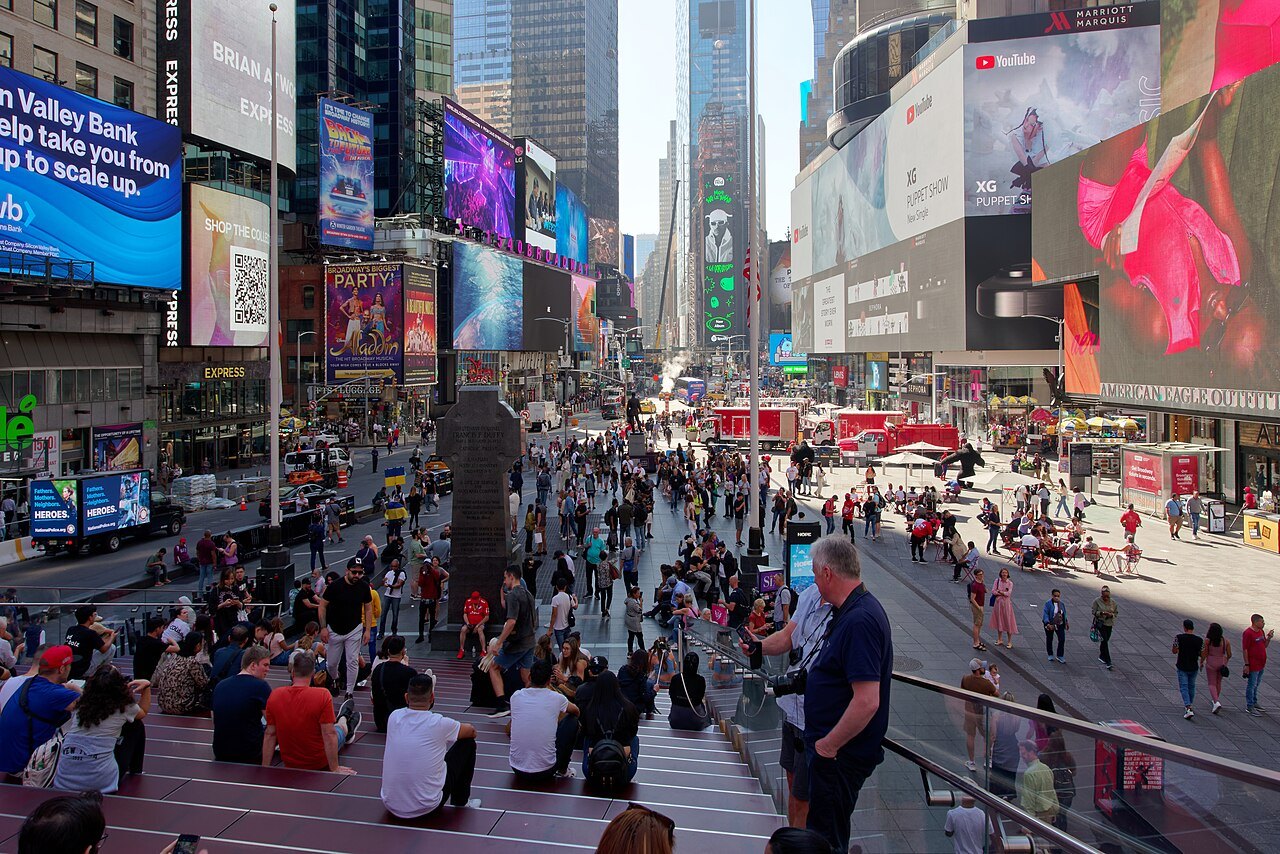
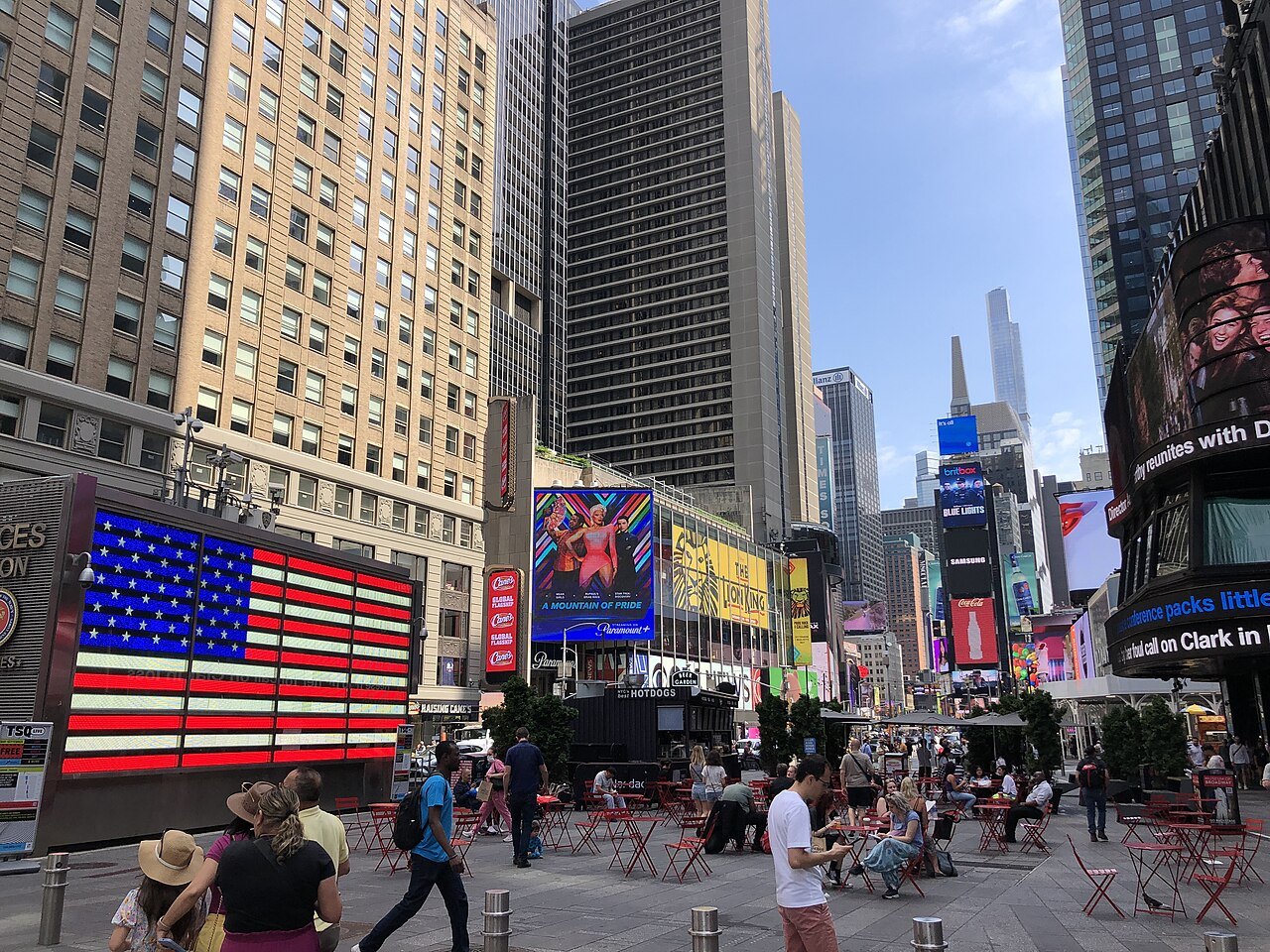
Stand at the southern end, near One Times Square, and look north: the open space widens ahead, framed on every side by moving video screens stacked many stories high. This is the tower the first ball was lowered from in 1907, and it still anchors the square both visually and historically.
The best overview is from the red glass steps at Duffy Square, the northern triangle at 47th Street, which rise above the TKTS discount ticket booth and give a grandstand view south down the whole square. Duffy Square is named for Father Francis Duffy, chaplain of New York's Fighting 69th Infantry Regiment, and his statue stands there alongside one of the composer and showman George M. Cohan.
Since 2009, the stretches of Broadway between 42nd and 47th Streets have been closed to cars and turned into pedestrian plazas, a trial begun under Mayor Michael Bloomberg to cut pollution and accidents and ease Midtown traffic. The surrounding Theater District, defined by the city from 40th to 57th Street between Sixth and Eighth Avenues, includes twenty-six landmarked Broadway theaters along with Shubert Alley and the Brill Building.
How to visit
Times Square costs nothing to visit and never closes, though it is at its most spectacular after dark, when the signs light the square brighter than day. Most visitors find a short stop enough rather than a long one, and the square sits along the route of the homepage walk along 42nd Street.
The TKTS booth beneath the red steps, run by the nonprofit Theater Development Fund since 1973, sells reduced-price tickets for Broadway and Off-Broadway shows; a second booth operates at Lincoln Center. For guidance on when it is worth waiting in line and when to book ahead instead, see booking ahead.
The Times Square–42nd Street subway station, one of the busiest in the system, sits directly beneath the square, and getting around covers the lines that stop there. On New Year's Eve, access and routing change for the ball drop, so visitors headed there that night should check current plans with the MTA and the city well in advance.
Nearby
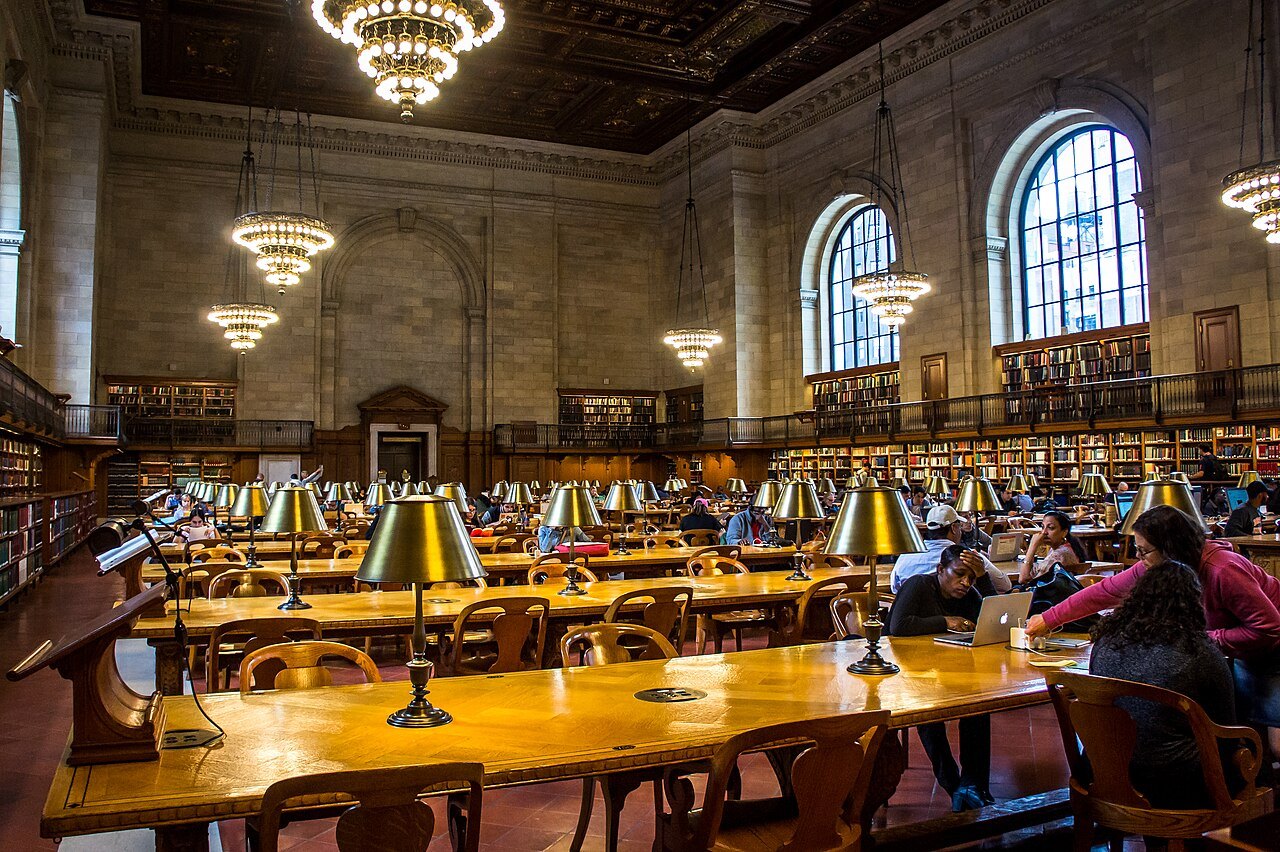
A walk east along 42nd Street leads from Times Square to the New York Public Library and the adjoining Bryant Park, both within easy walking distance. Pairing the two makes a natural extension of a Times Square visit, moving from the electric signs of the square to quieter reading rooms and lawns a few blocks away.
A walk east along 47th or 48th Street instead leads to Rockefeller Center, another Midtown landmark built in the same decades that saw Times Square's rise and later decline. Both routes are short and flat, and either one makes it easy to see both landmarks without planning a separate outing.
Central Park begins twelve blocks north of the square, at 59th Street, and can be reached on foot or by subway for visitors who want greener surroundings after the crowds and light of Times Square. The walk north passes through a changing stretch of Midtown before reaching the park's southern edge.
Read next03
More from the journal
- The GridWhat is Manhattanhenge, and where should you watch it?Four days a year the sun rises or sets exactly along Manhattan's cross streets, because the grid of 1811 is tilted 29 degrees. Why it happens, when, the difference between the half sun and the full sun, and which streets give the best view.Read the piece →
- The Flatiron Building and Madison SquareWhy is the Flatiron Building shaped like a wedge?Why Broadway's diagonal cut across the grid left a wedge of land at 23rd Street, and how the Flatiron Building filled it.Read the piece →
- The Empire State BuildingHow was the Empire State Building built in just over a year?How a Depression-era race among three towers raised the Empire State Building in just over a year.Read the piece →