Home · Sights · The Guggenheim
What you are looking at01
The Guggenheim Museum
Fifth Ave · E 88–89 St
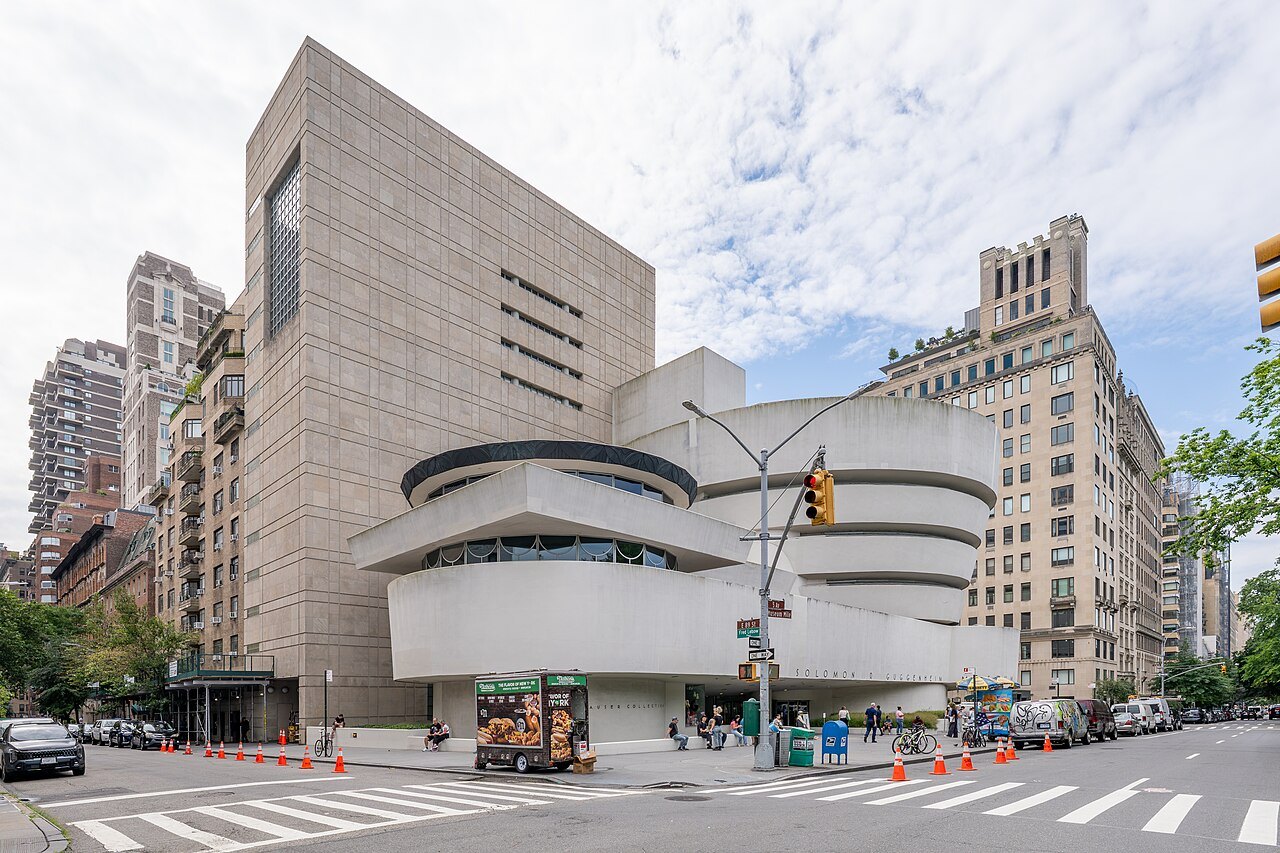
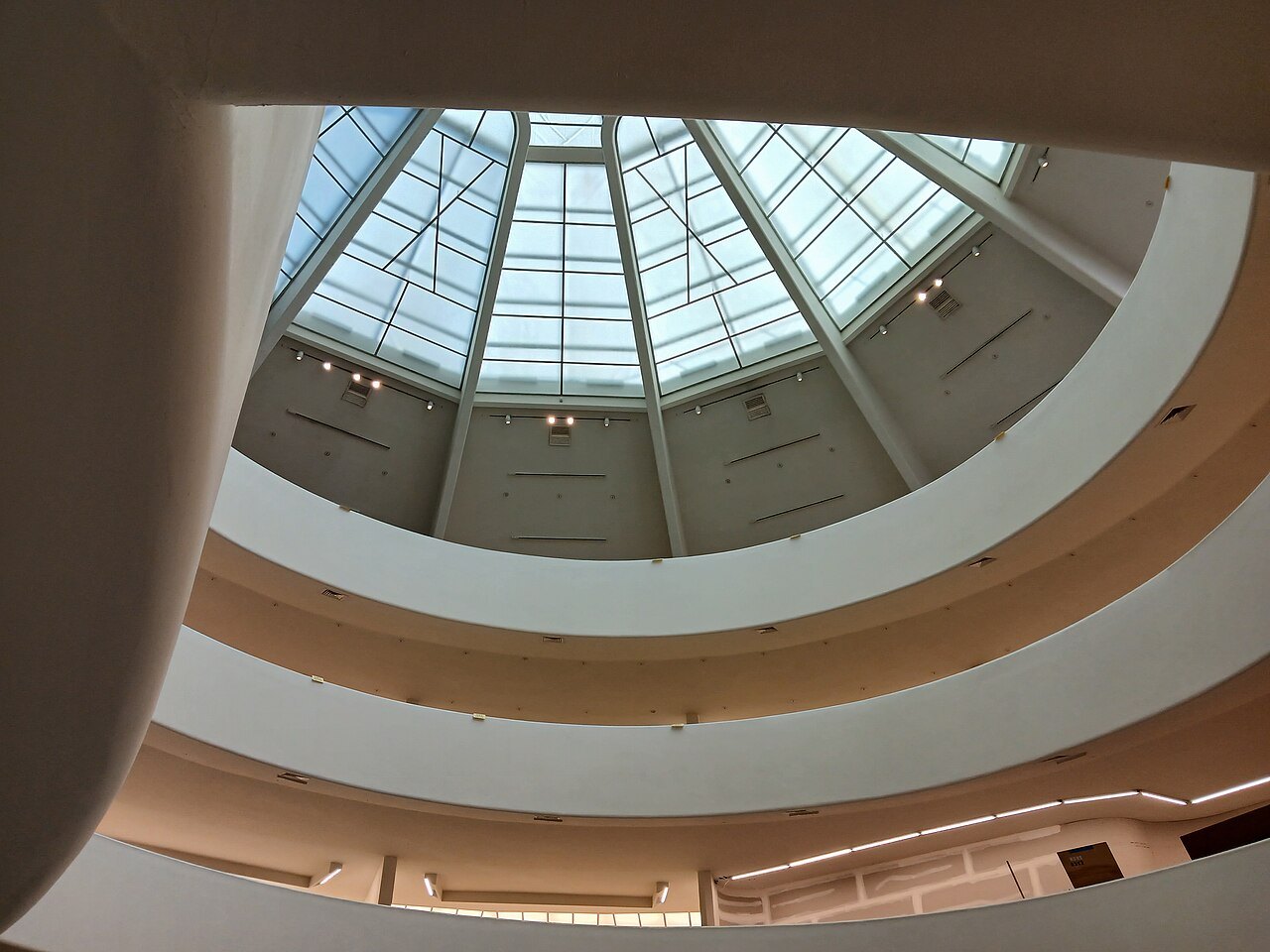
- 1The rotundaThe open main gallery, a bowl of stacked concrete bands rising to a central skylight.
- 2The rampA helical ramp that climbs six stories along the rotunda's walls, with the exhibition hung along it.
- 3The Thannhauser CollectionImpressionist, Post-Impressionist and modern French works, from Degas and Manet to Van Gogh.
- 4The founding collectionKandinsky and the early modernists that Solomon Guggenheim and Hilla Rebay gathered.
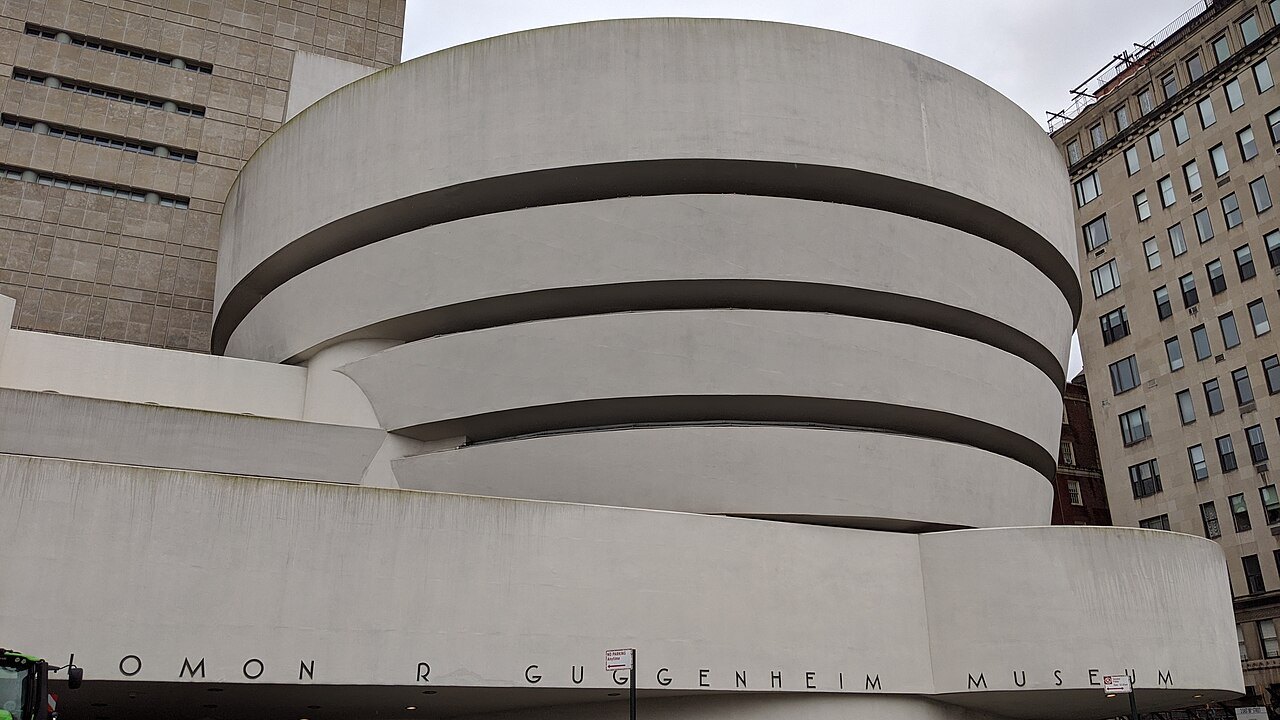
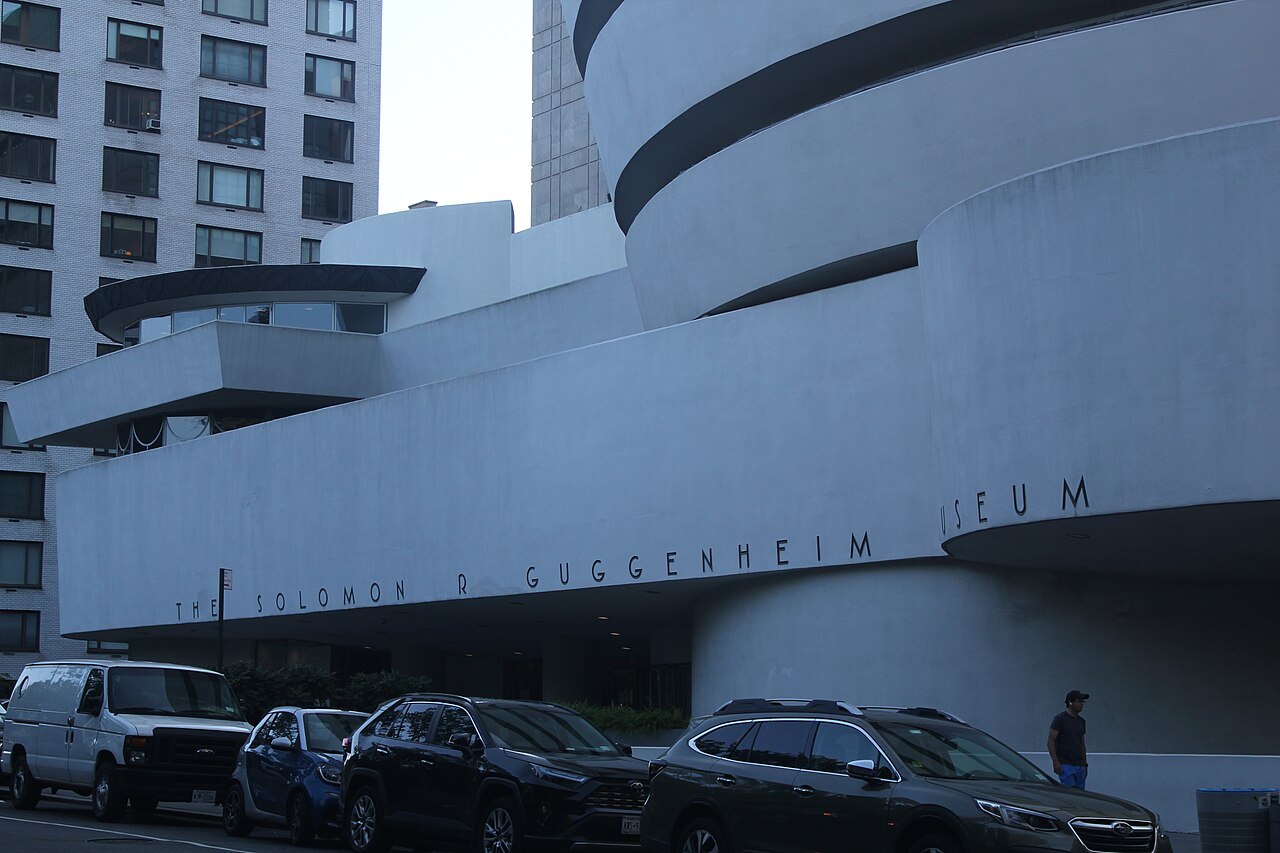
- 5The facadeThe curved, banded exterior on Fifth Avenue, facing Central Park across the street.
The sight in full02
Reading the place
Why it matters
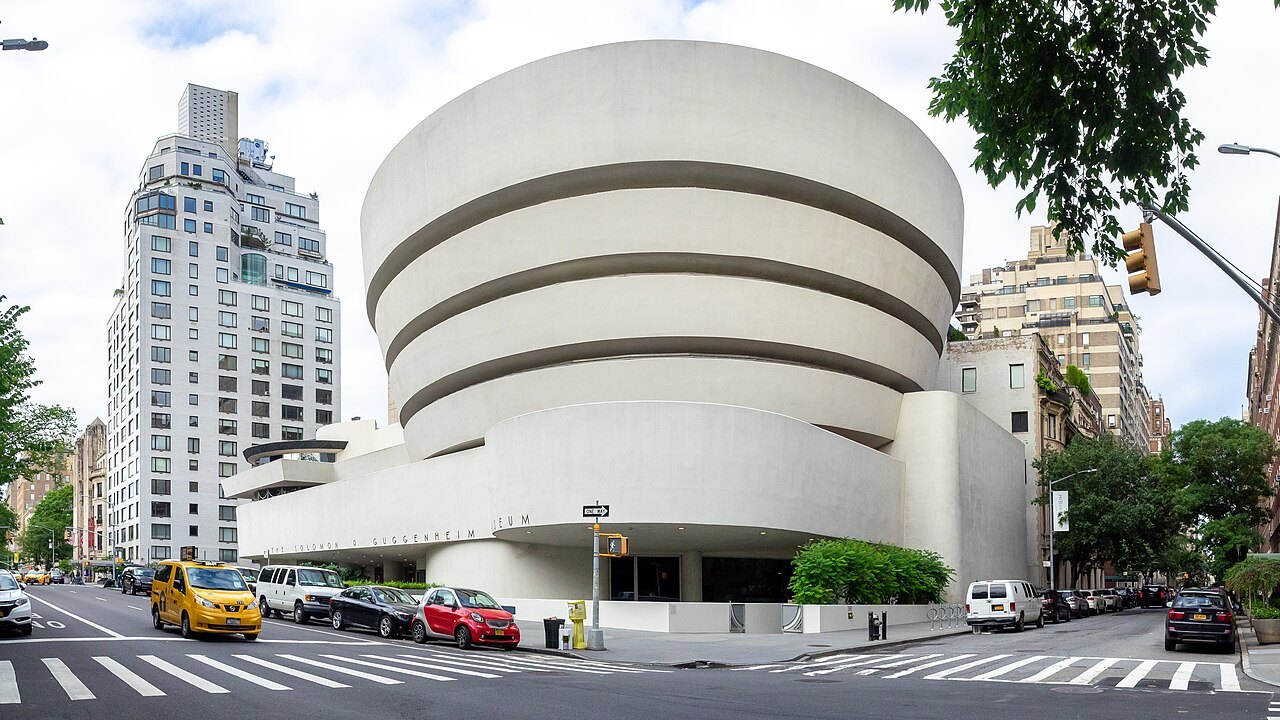
The Solomon R. Guggenheim Museum, which everyone calls the Guggenheim, stands at 1071 Fifth Avenue, between 88th and 89th Streets, on the part of Fifth Avenue known as Museum Mile. It is a museum of modern art, with a permanent collection of Impressionist, Post-Impressionist, early modern and contemporary works and a program of special exhibitions throughout the year.
But most visitors come for the building. Designed by Frank Lloyd Wright and completed in 1959, it is one of the landmark works of twentieth-century architecture: a smooth, pale spiral that sits among the boxy apartment houses of the Upper East Side like something landed from another world. In 2019 UNESCO added it to the World Heritage List as one of eight buildings under the title The 20th-Century Architecture of Frank Lloyd Wright. It is the only museum Wright ever designed, and his last major work.
How it came to be
Solomon R. Guggenheim came from a wealthy mining family and began by collecting Old Masters. In 1926 he met the artist Hilla von Rebay, who introduced him to the European avant-garde and to abstract art she called non-objective, and he changed course completely, collecting the work of Wassily Kandinsky and his contemporaries. At first he showed the collection in his apartment at the Plaza Hotel. In 1939 his foundation opened the Museum of Non-Objective Painting on East 54th Street in Midtown, with Rebay as its director.
In 1943 Rebay and Guggenheim wrote to Frank Lloyd Wright asking him to design a permanent home. Rebay had assumed the architect, then seventy-six, was dead; Guggenheim's wife knew better. Rebay asked him for a temple of spirit, a monument. In 1944 the foundation bought the site on Fifth Avenue facing Central Park, whose green Guggenheim valued as relief from the noise and concrete of the city.
It took Wright fifteen years, more than 700 sketches and six sets of working drawings to get it built, and the cost doubled. Guggenheim died in 1949 and the museum took his name in 1952. Rebay, who disagreed with the family's plans, resigned as director that year, though she left part of her own collection to the foundation in her will. Wright himself died in April 1959, six months before the building opened.
What you actually see
From Fifth Avenue the building is a stack of curved concrete bands, widening as they rise, the opposite of the stepped towers of Mesopotamia; Wright's early concept was called an inverted ziggurat. The facade was sprayed concrete, and restorers found that it was first painted a brownish yellow before decades of white and off-white coats.
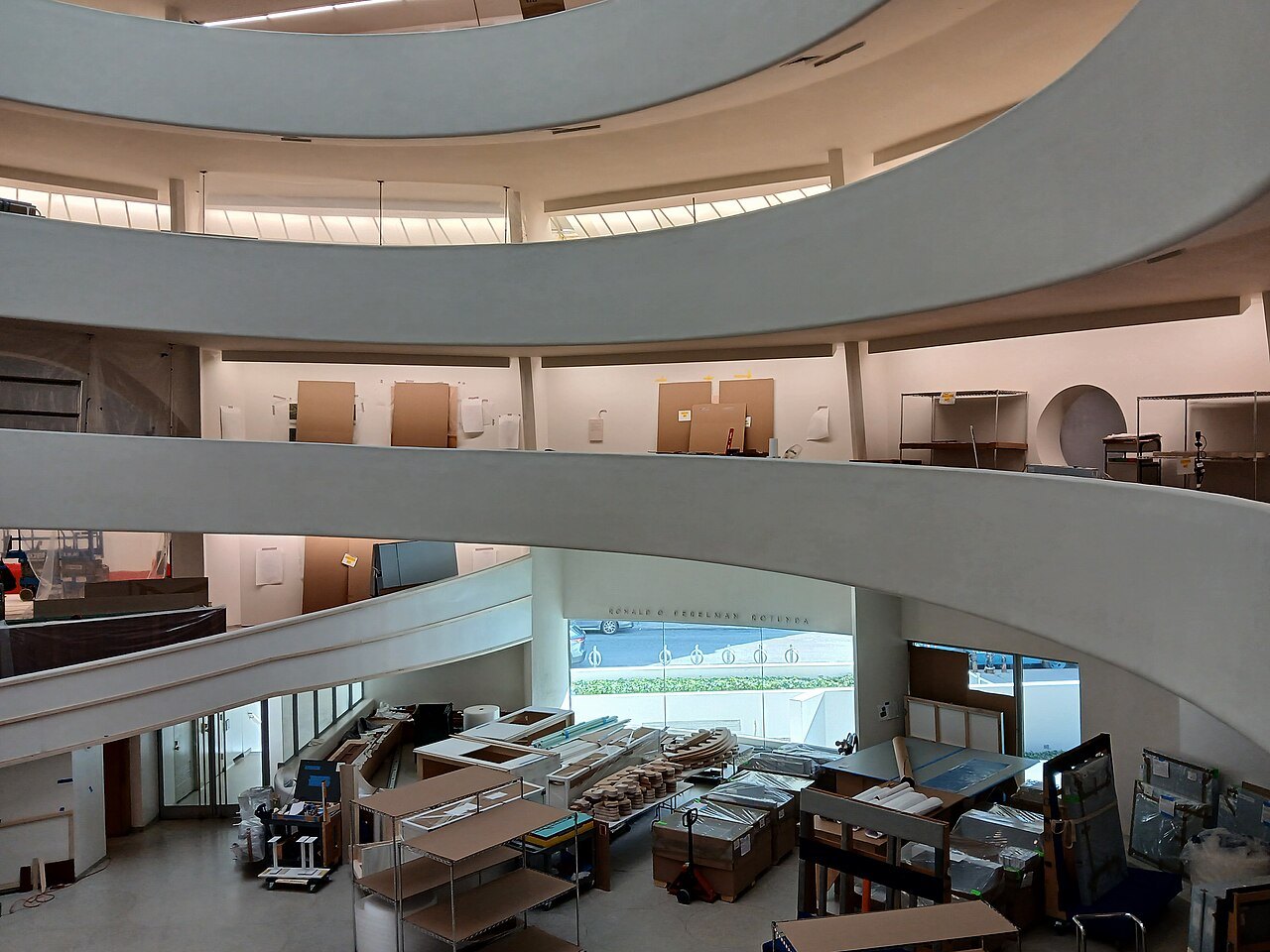
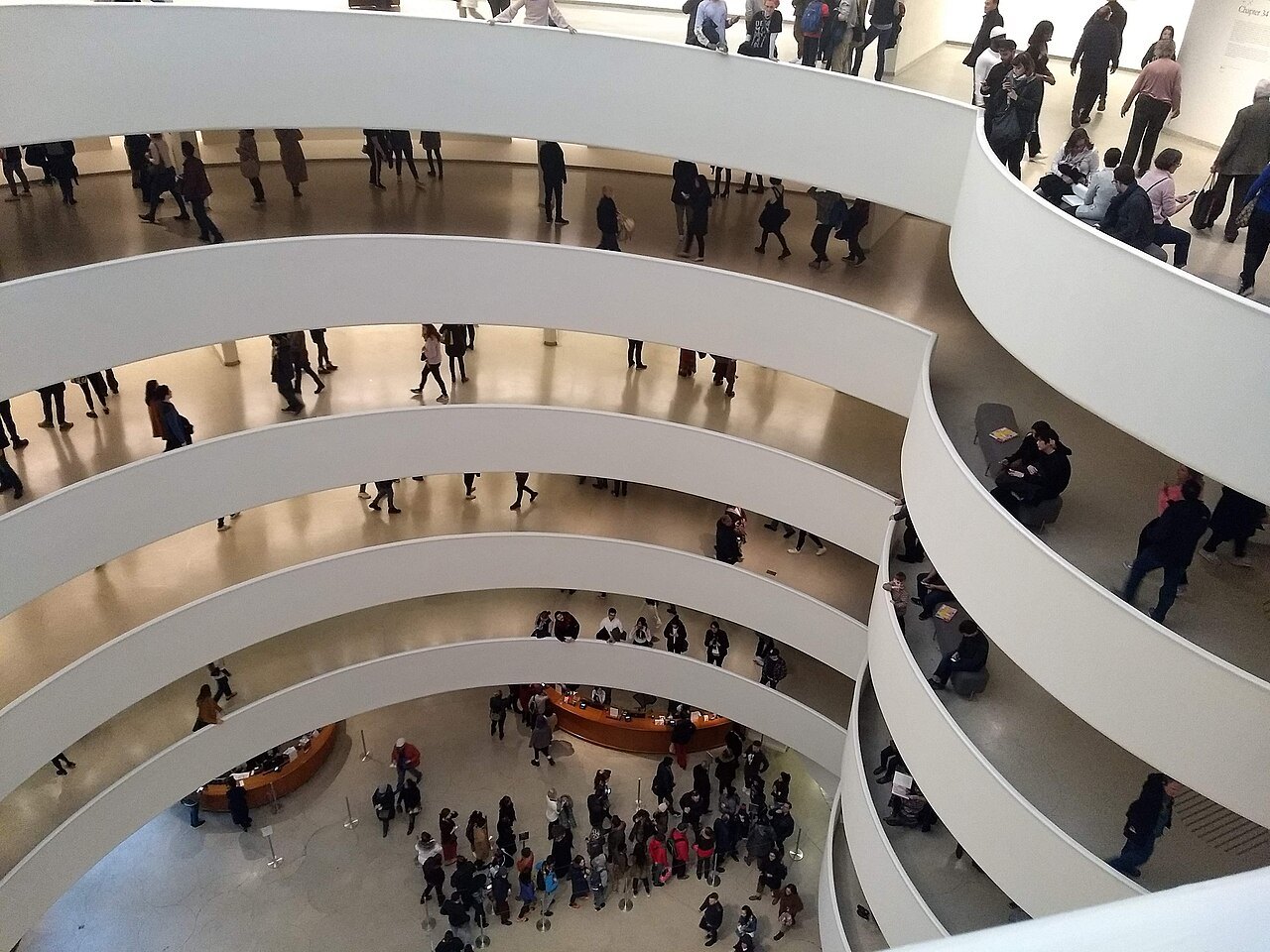
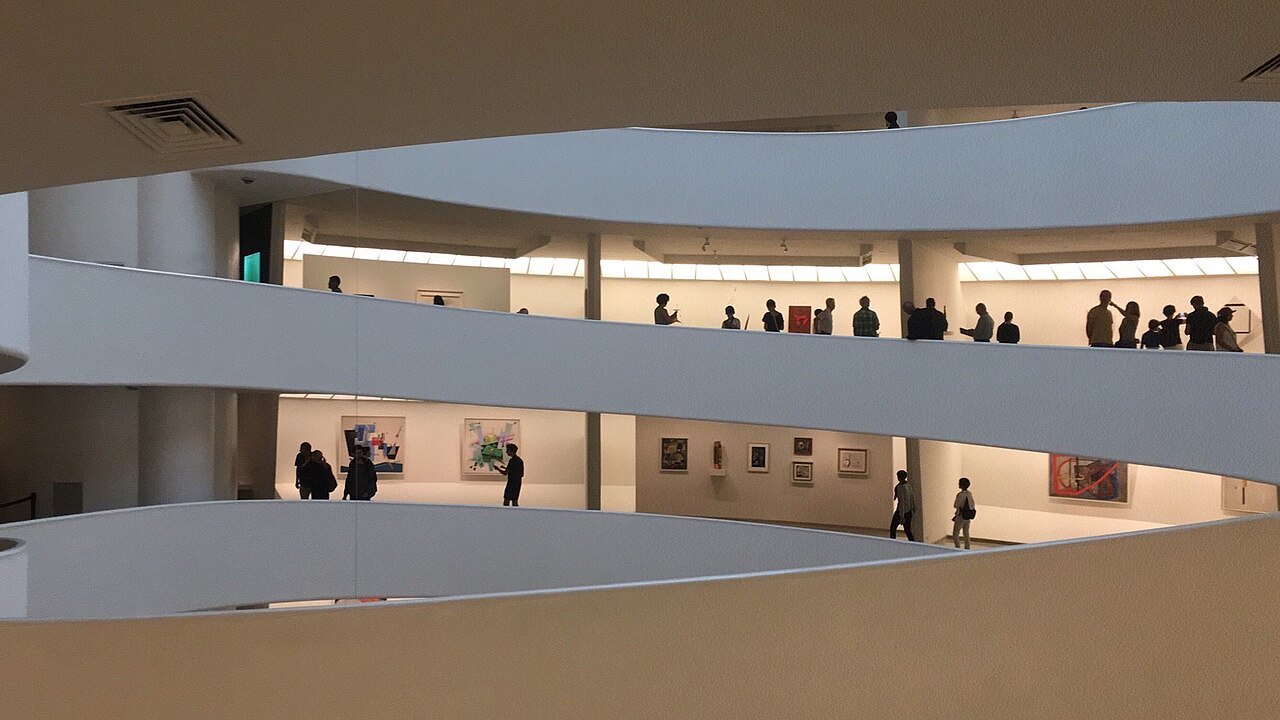
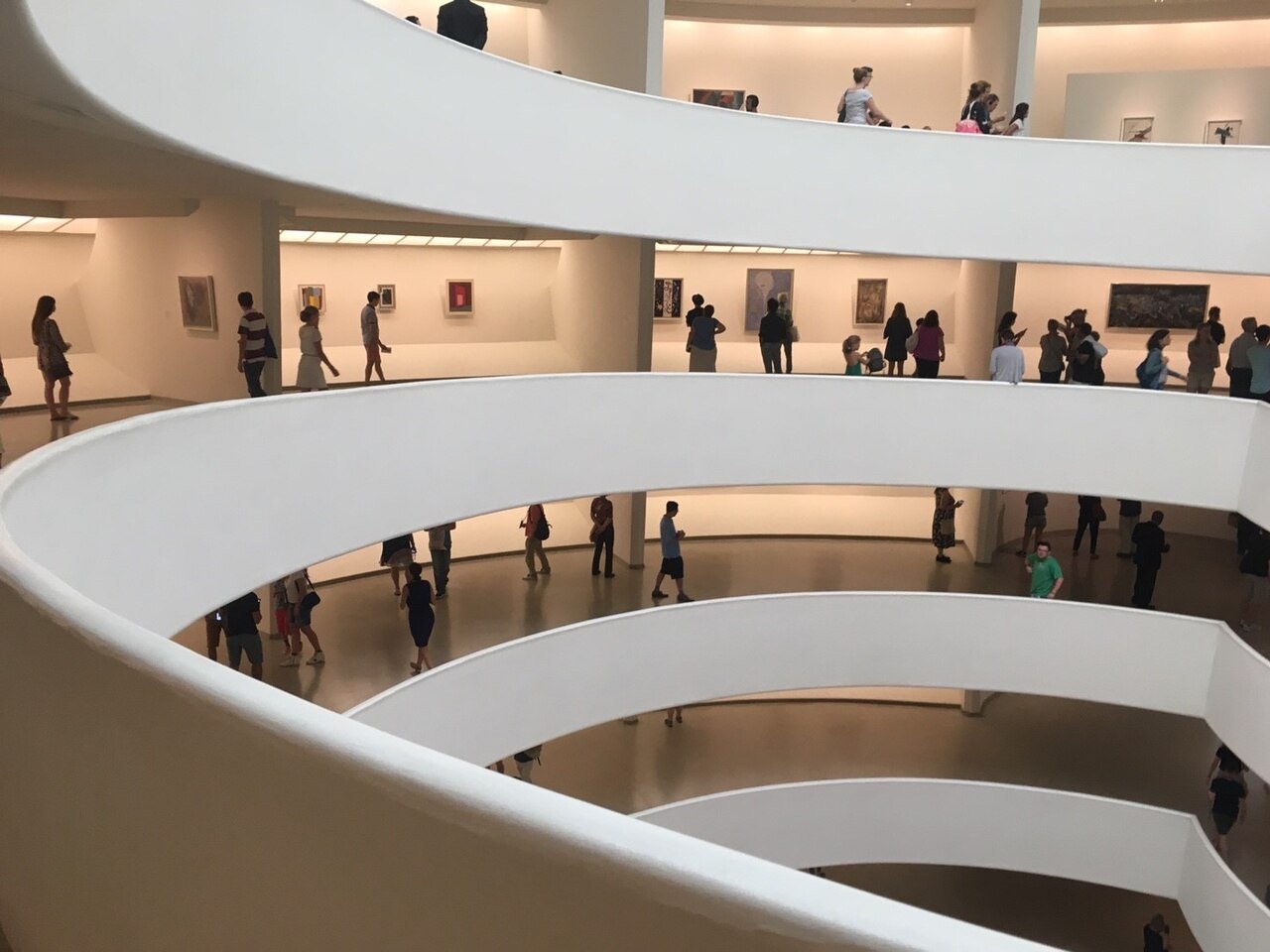
Inside, the main gallery is one open rotunda. A helical ramp climbs six stories around its walls to a skylight at the top, and the exhibitions hang along the ramp, so that as you walk you see art on the wall beside you and, across the void, people looking at art on every other level. Wright wanted a floor that a wheelchair could follow from bottom to top; the usual way to see it is to take the elevator in the triangular service core to the top and walk down the gentle slope.
The walls tilt and curve, and from the start curators argued about how to hang paintings on them; the museum's director of the 1950s, James Johnson Sweeney, painted them white and hung the pictures from metal bars against Wright's wishes. The building was criticized for exactly this when it opened and was widely praised afterward, and the critic Paul Goldberger argued that it made it acceptable for architects to design intensely personal museums, so that almost every museum since is in some sense its child. Its engineers were sure the concrete shell would not crack and built it without expansion joints; they were wrong, and a renovation from 2005 to 2008 repaired the cracks and restored the exterior details. In 2023 nearly 861,000 people came to see it.
The collection
Beside the rotunda, in the smaller round building Wright called the monitor, the Thannhauser Collection fills the top three floors with Impressionist, Post-Impressionist and modern French works, among them paintings by Degas, Manet and Van Gogh. The ten-story annex behind the rotunda, added by Gwathmey Siegel in the renovation of 1990 to 1992, holds further galleries.
The founding collection includes the early modernists Rebay championed: Kandinsky, Piet Mondrian, Marc Chagall, Robert Delaunay, Fernand Léger, Amedeo Modigliani and Pablo Picasso, with works such as Chagall's Green Violinist, Franz Marc's Yellow Cow and Picasso's The Accordionist. The whole collection, around 8,000 works, is shared with the sister museums in Bilbao and Venice, so what hangs in New York changes with the exhibitions.
How to visit
The museum keeps regular daily hours with occasional early closings and closed days, so check its site before you go. Admission is charged for adults, and children under twelve go free. The museum recommends reserving tickets online in advance, though tickets can also be bought at the door; booking ahead explains how. A free visitor brochure maps the current exhibitions, and there is a digital guide in the Bloomberg Connects app. Café Rebay looks out toward Central Park.
Several subway lines stop on Lexington Avenue, a few blocks east, and buses run up Madison and Fifth Avenues; getting around covers them.
Nearby
Walk south down Museum Mile to the Metropolitan Museum of Art, or cross Fifth Avenue into Central Park at the Jacqueline Kennedy Onassis Reservoir.
Where to go next03
Nearby
- Nearby · 1000 Fifth AveThe Metropolitan Museum of ArtThe largest art museum in the Americas, almost a quarter of a mile long on the edge of Central Park: an Egyptian temple under glass, a Ming garden court, knights on horseback and five thousand years of painting under one roof.Read the page →
- Nearby · 59 St → 110 StCentral ParkThe 843 acres the grid left open: a landscape built by hand in the 1850s and 1860s to look like nature, with a lake, a terrace, a castle on a rock, and fifty blocks of lawns and woods between the towers.Read the page →
- Nearby · Fort Tryon ParkThe CloistersMedieval Europe on a hilltop at the top of Manhattan: four French and Catalan cloisters shipped over stone by stone, the Unicorn Tapestries, a Romanesque apse from Spain, and gardens looking out over the Hudson.Read the page →