Home · Eating & Drinking
The island's own01
What to order
On the board
- The bagelA ring of yeasted dough, boiled and then baked, brought by Polish Jewish immigrants; eaten with cream cheese and lox, and never toasted.
- The sliceNew York–style pizza: a wide, thin, hand-tossed crust, crisp only at the edge, sold by the slice and folded to eat.
- Pastrami on ryeNew York's signature sandwich, first served in 1888 on Delancey Street and piled high in the Jewish delis of the Lower East Side.
- CheesecakeThe dense cream-cheese cake of the city's Jewish restaurants and delis, made famous in the 1930s.
- The egg creamA cold fountain drink of milk, seltzer and chocolate or vanilla syrup, with neither egg nor cream in it.
- The halal cartChicken or lamb over yellow rice with red and white sauces, from the carts that stand on Midtown's corners.
- The hot dogThe sausage in a bun, sold from street carts all over the city and tied to New York since the nineteenth century.
In full02
Eating & Drinking
A city that eats on the move
New Yorkers eat everywhere: at counters, from carts, walking down the avenue with a slice folded in one hand. The city has restaurants of every cuisine and every level of ambition, from counters that have been open for more than a century to the most famous dining rooms in the country, and no guide could list them. What a visitor can do is learn the handful of foods that belong to this island, where they came from, and where they are still made the old way.
Almost all of them are immigrant foods. Jewish families from Eastern Europe, Italians from Naples and the south, Chinese from Canton and Fujian, and in recent decades newcomers from Egypt, Bangladesh and Afghanistan each brought a kitchen with them, and in the crowded streets of the Lower East Side, Little Italy, Chinatown and Midtown those kitchens became New York food.
The Jewish deli and the bagel
The bagel is a bread roll that began in the Jewish communities of Poland, first recorded in Kraków in 1610. It is shaped by hand into a ring, briefly boiled in water and then baked, which gives it its chewy crust. Polish Jewish immigrants brought it to New York, where for decades the business was controlled by a single bakers' union. Around 1900 the bagel brunch became popular: a bagel topped with lox, cream cheese, capers, tomato and red onion. In New York, toasting a good fresh bagel is considered close to a crime.
The Jewish delicatessen is the other great institution. The first delicatessens in the country appeared in New York in the early 1880s, serving the German immigrants, and kosher delis followed. At their height, in the 1930s, the city had about fifteen hundred Jewish delis; by 2015 only fifteen were left. Their signature is pastrami on rye, created in 1888 by the Lithuanian immigrant Sussman Volk, who served it at his deli at 88 Delancey Street on the Lower East Side.
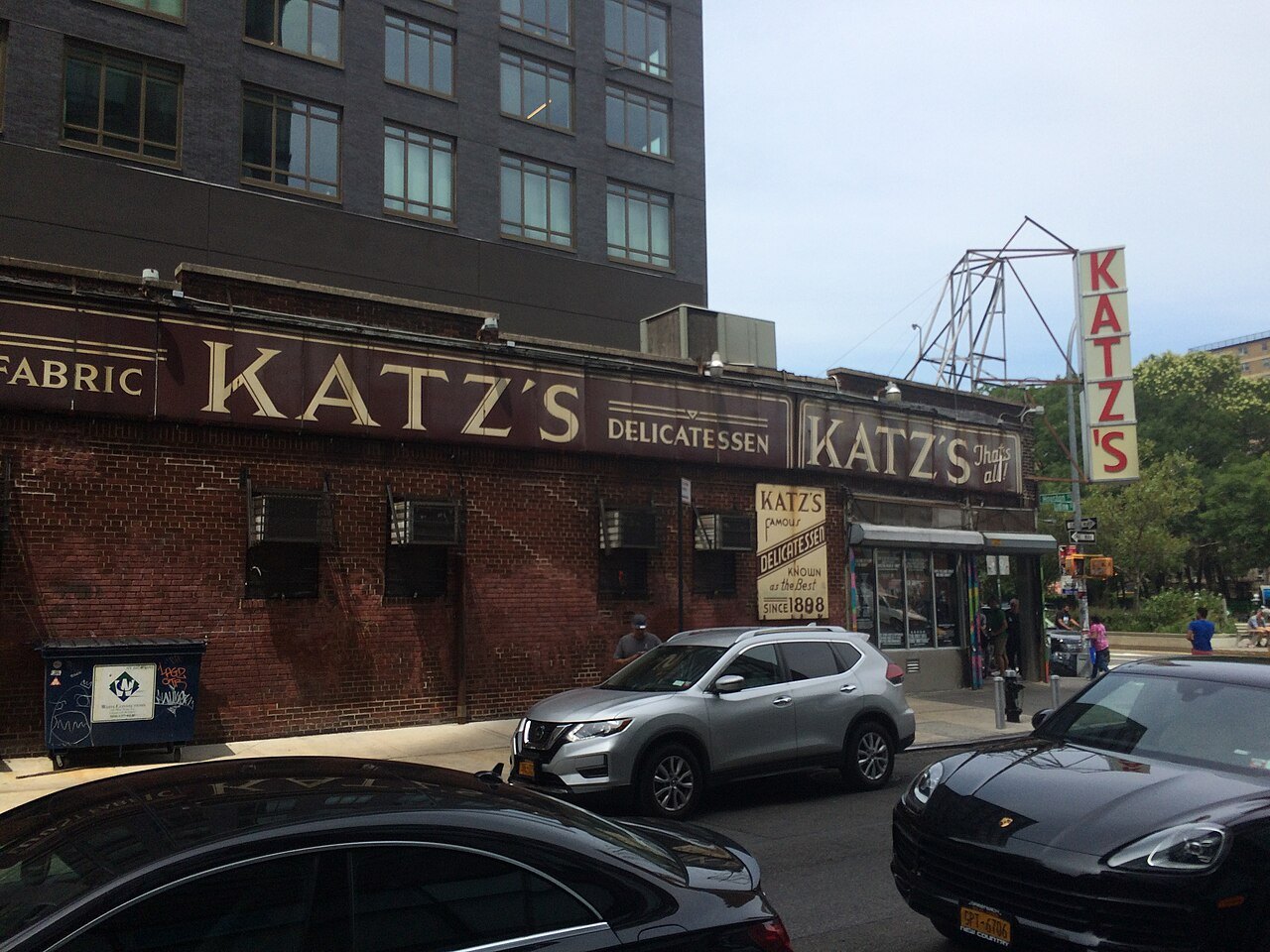
The most famous survivor is Katz's Delicatessen, at the corner of Houston and Ludlow Streets on the Lower East Side, in business since 1888. It is not kosher, but its pastrami on rye is counted among the best in the city, and it serves some fifteen thousand pounds of pastrami a week. Expect a line and a sandwich too big to finish.
The slice
New York–style pizza grew out of the Neapolitan pizza that Italian immigrants made in the city in the early 1900s. The first pizzeria in the United States is said to be Lombardi's, founded by Gennaro Lombardi in Little Italy in 1905, though historians have challenged the claim. The New York version has a large, thin, hand-tossed crust that is thick and crisp only at its edge and soft enough beneath its toppings to be folded lengthwise, which is how New Yorkers eat it, standing up.
It is sold by the slice, to go, from small shops all over the island, and it is the quickest good meal in Manhattan. Little Italy itself has shrunk to a few blocks of restaurants along Mulberry Street north of Canal Street, but the slice is everywhere.
Cheesecake and the egg cream
New York–style cheesecake is made with a cream-cheese base, which gives it its dense, rich texture. Cream cheese was invented in New York State in 1872, and the cake was made famous in the 1930s by Jewish restaurants and delis such as Reuben's and Lindy's, whose owners both claimed the recipe.
The egg cream is a cold fountain drink of milk, seltzer and flavored syrup, usually chocolate, and despite its name it contains neither egg nor cream. It came from the Yiddish-speaking Jewish immigrants of the city; one explanation of the name is that egg is a corruption of the Yiddish echt, genuine. Order one at a deli or an old-fashioned soda counter, and drink it at once, while the foam on top still stands up.
Street food
The hot dog has been tied to New York since the nineteenth century, and the carts that sell them stand on corners all over Midtown; one story credits a pieman at Coney Island, Charles Feltman, with first serving the sausage in a roll.
Since the 1990s the hot dog carts have been joined, and on many corners replaced, by the halal cart. Its origin is disputed, but one of the first was The Halal Guys, which began as a hot dog cart in Midtown before switching to halal food. The classic plate is chicken or lamb gyro over yellow rice and salad, with a white sauce and a fiery red one. As the carts' owners changed, so did the menu. A study found that between 1990 and 2005 the number of the city's street vendors who had come from Germany and Italy fell from 306 to none, while those from Egypt, Bangladesh and Afghanistan rose from 69 to 563.
Carts are a meal in a few minutes, and many New Yorkers eat lunch standing on the sidewalk. Their spread across the city has been compared to that of the taco trucks of Los Angeles.
Where to eat
Chinatown has the highest concentration of people of Chinese descent outside Asia, and restaurants are one of its main industries, from the old Cantonese places around Mott Street to the large dim sum restaurants on East Broadway, the stretch known as Little Fuzhou. On the Lower East Side, walk from Katz's along Orchard Street, the heart of the old immigrant quarter. In the West Village the streets around Greenwich Village are thick with cafés and small restaurants.
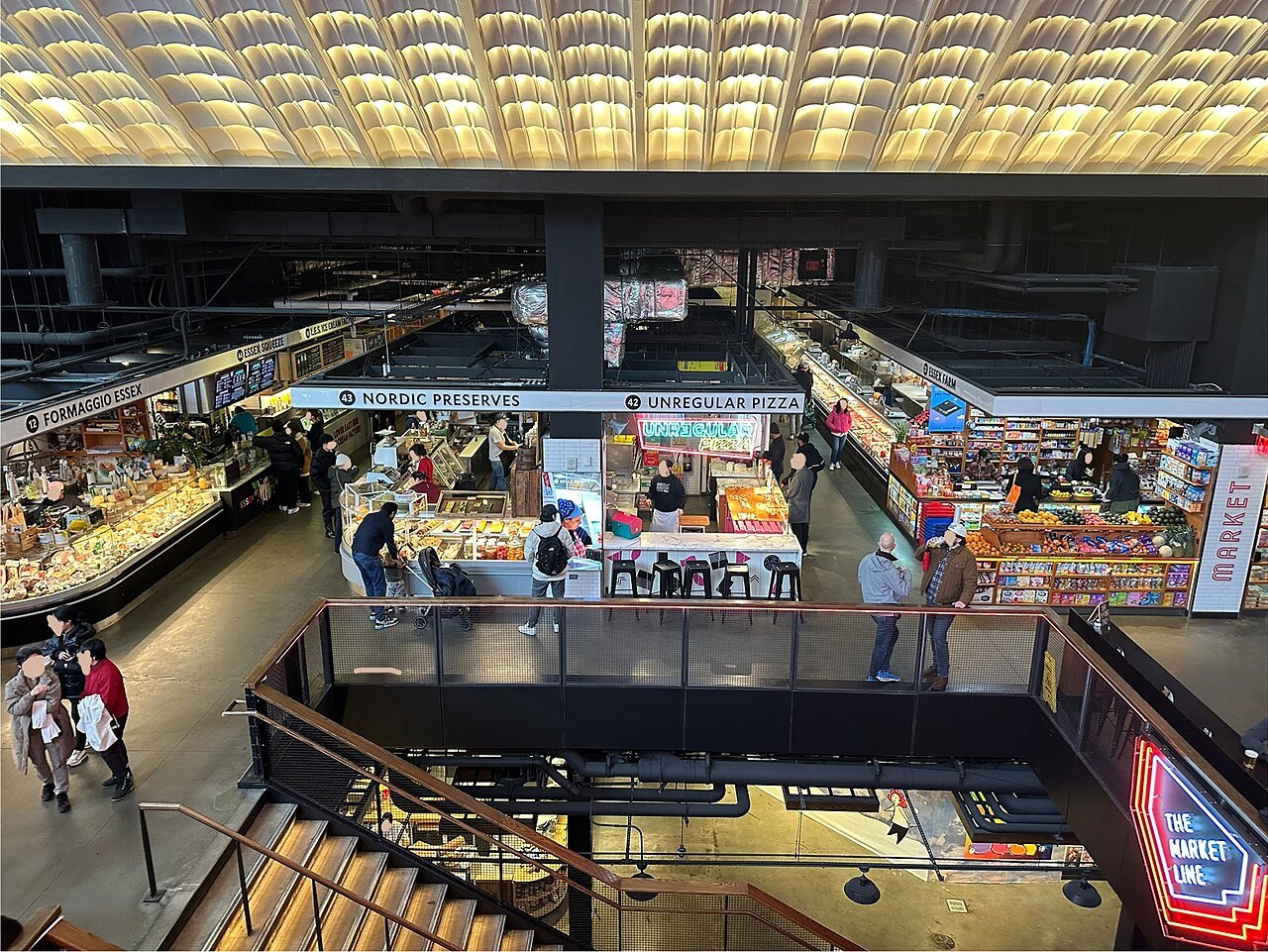
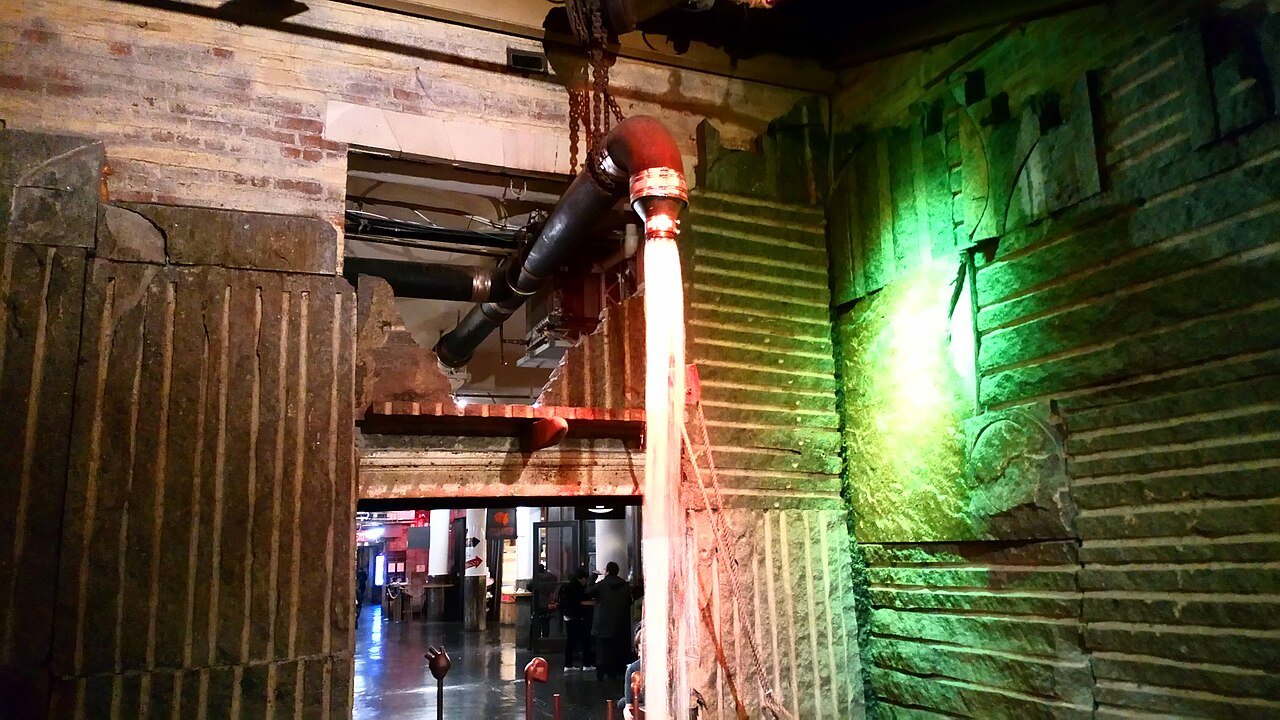
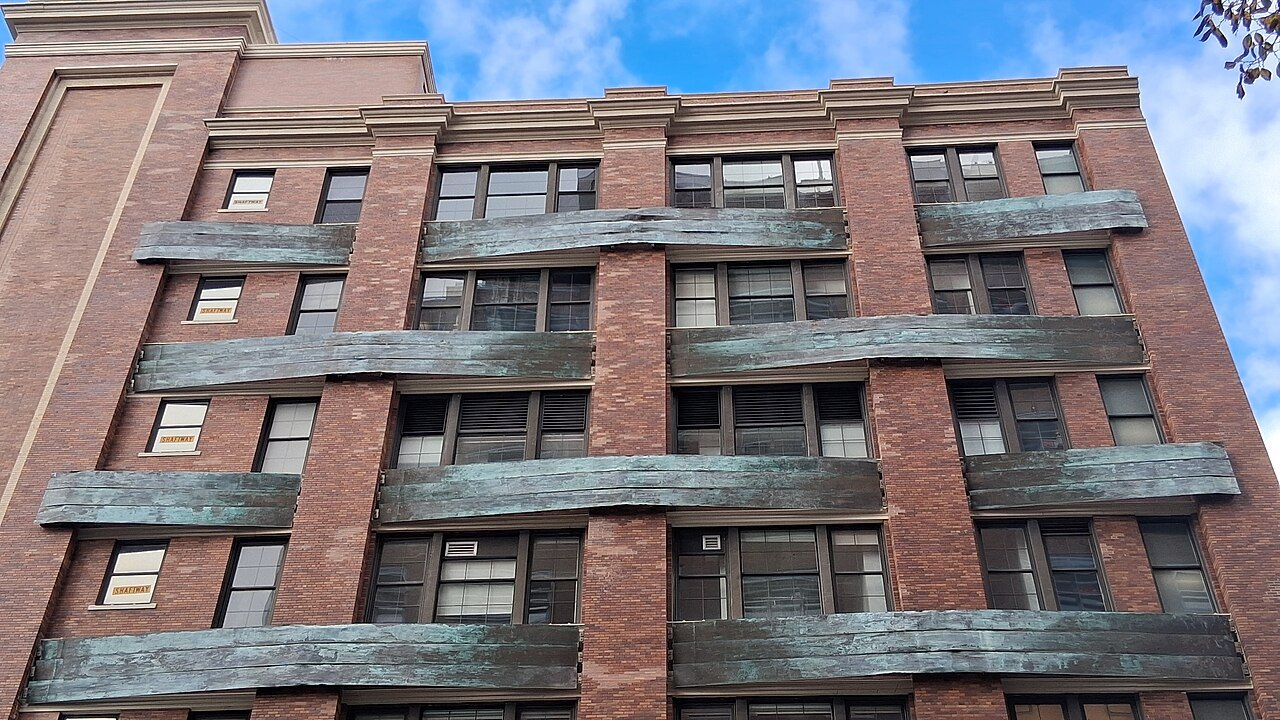
Chelsea Market, a whole city block beside the High Line, which passes through its Tenth Avenue side, is a food hall built inside the old Nabisco factory complex where the Oreo cookie was invented; it is the easiest place to sample a lot of the city in one stop. Grand Central has its own food hall and the Oyster Bar on its lower level. For a meal with a view, the views lists the decks, some of which have bars.
Seen on the way03
More photographs
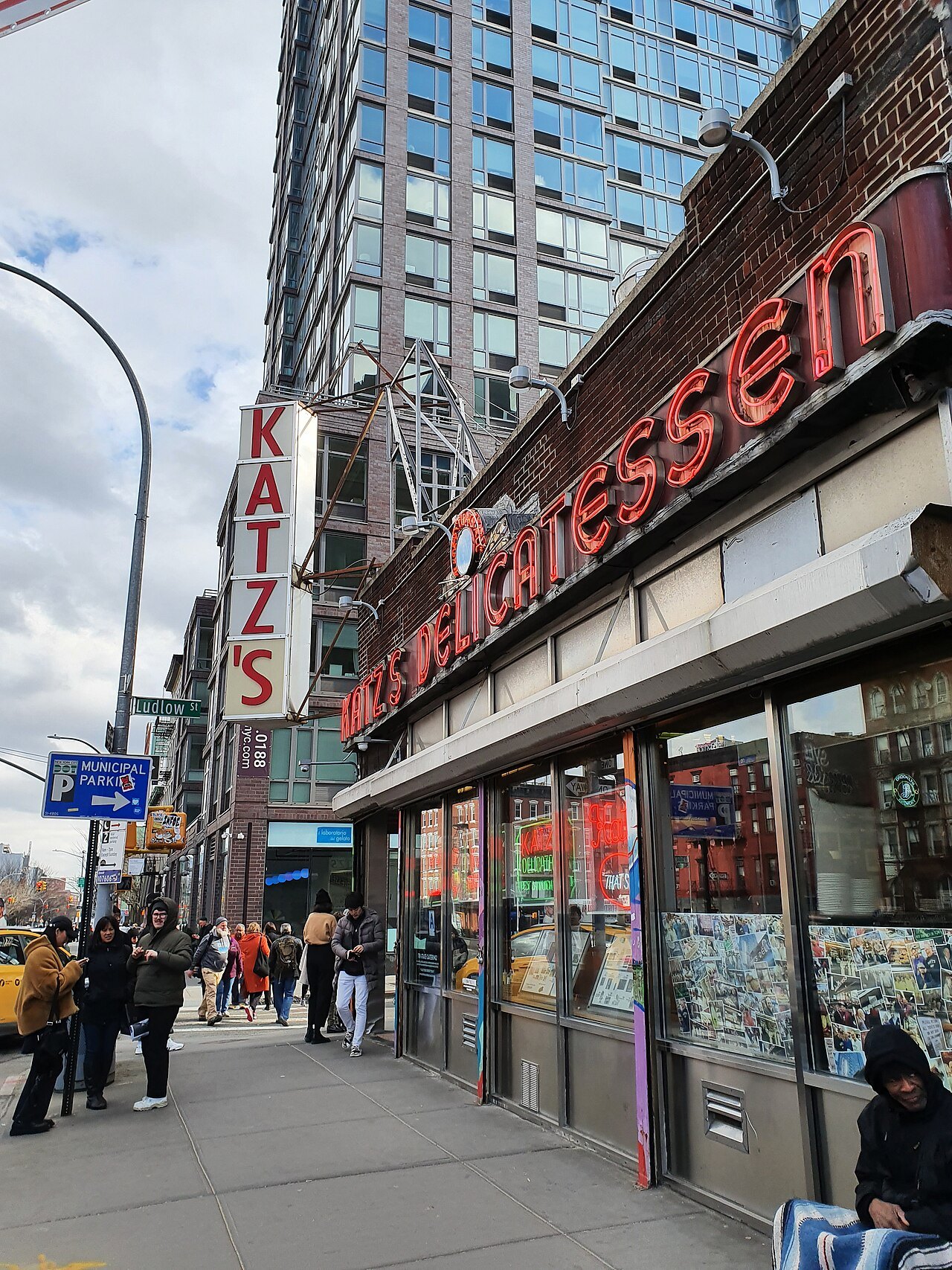
Katz's Delicatessen's long sign along Houston StreetMig Gilbert from Brighton, Wikimedia Commons, CC BY-SA 2.0 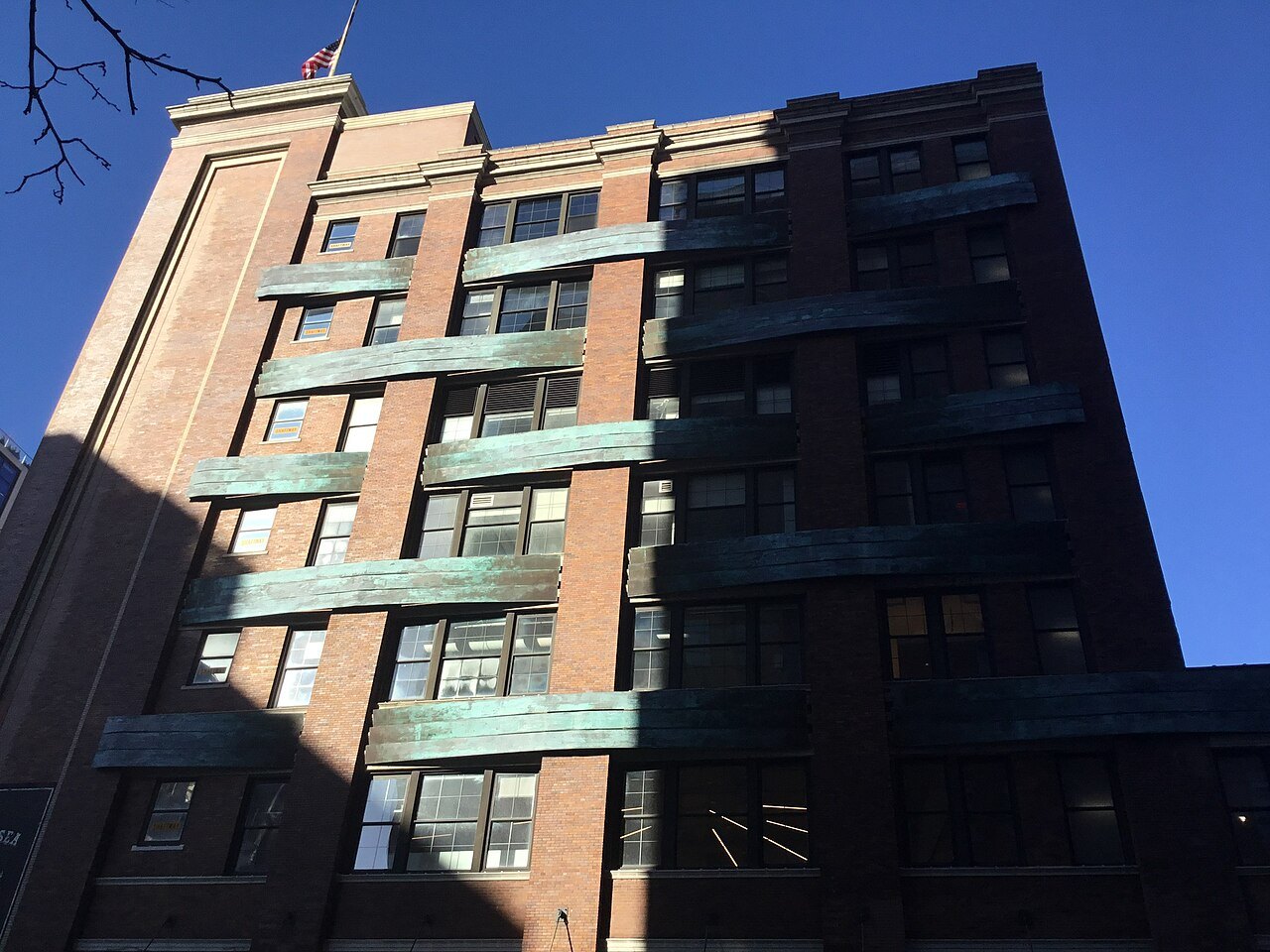
Chelsea Market's brick and green-copper facade in winter lightKidfly182, Wikimedia Commons, CC BY-SA 4.0